

 русский
 عربى

Industry News
Home / News / Industry News / CNC Machining Centers Explained: Types, Key Specifications, and How to Choose
CNC Machining Centers Explained: Types, Key Specifications, and How to Choose
 2026.09.23
 Industry News
A machining contractor once brought us a quotation for 2,000 pump housings with a simple requirement: a ±0.008 mm bore tolerance, documented on every part. The shop's manual mills could hit that number on a good day, but not shift after shift, and not with the measurement records the customer demanded. The order went to a shop running CNC machining centers. The owner's question afterwards was exactly the one every buyer should ask: which type of machining center do I actually need, and which specifications really decide whether it will make money?
Content
- 1 What Defines a CNC Machining Center?
- 2 The Three Main Configurations
- 3 Key Specifications That Decide Real-World Performance
- 4 Matching the Machine to the Part: A Radar Comparison
- 5 Where Machining Centers Earn Their Keep
- 6 Cost of Ownership: What Adds Up Over Five Years
- 7 Maintenance Points That Protect the Investment
- 8 Frequently Asked Questions About CNC Machining Centers
- 8.1 Q1. What is a CNC machining center?
- 8.2 Q2. What is the difference between a VMC and an HMC?
- 8.3 Q3. How much does a CNC machining center cost?
- 8.4 Q4. What do 3-axis, 4-axis, and 5-axis mean?
- 8.5 Q5. Can a machining center replace a CNC milling machine?
- 8.6 Q6. What is a gantry machining center used for?
What Defines a CNC Machining Center?
Put a machining center next to a CNC milling machine on a shop floor and the visible difference is the automatic tool changer (ATC). A CNC machining center is a computer-numerically-controlled machine tool designed to carry out milling, drilling, boring, tapping, and reaming in one setup, pulling tools from a magazine and changing them without the operator's hands. That one capability turns a single-tool cutting operation into a sequential process: the machine can face the part, drill its holes, bore the critical diameters, and tap the threads — all in one program cycle.
Why does that matter on the cost side? Because every manual tool change is a source of variation. The tool sits differently in the holder, the operator's tightening torque differs, and the spindle warm-up state changes. A machining center removes those variables, which is why repeatability, not speed, is the real reason shops upgrade. The schematic below shows the main components you will evaluate on any machining center — the column, spindle head with its drive, the worktable, the tool magazine, the control panel, and the base that carries the whole structure.
Main components of a CNC machining center
For a more detailed walkthrough of how the control system coordinates spindle, axes, and tool changes, our guide to what a CNC machining center is and why it matters explains the control loop step by step.
The Three Main Configurations
Almost every machining center on the market falls into three families. The choice is driven by the shape of the workpiece, the number of faces that need machining, and the size of the part.
Vertical Machining Centers (VMCs)
The VMC keeps the spindle perpendicular to the table. It is the default for flat parts, mold plates, brackets, and any workpiece whose critical features are accessible from above. Setup is straightforward because the table is open on three sides, and the initial investment is the lowest of the three families. For a shop cutting typical production parts up to roughly 1,000 mm in X travel, a VMC delivers the best ratio of capability to invested capital. The EV850 economical VMC is a representative entry point for shops stepping up from manual milling.
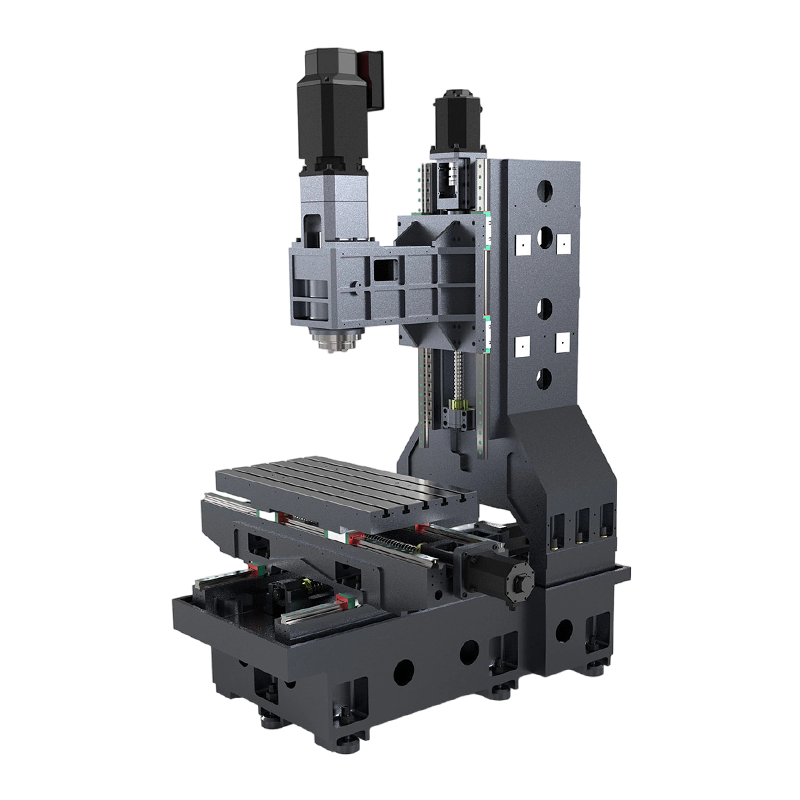 EV850 Economical Vertical Machining Center for Production ShopsThis VMC offers an affordable entry point for shops moving from manual milling, with a design that eases crane loading, maintenance access, and one-key HMI operation.View Product →
Horizontal Machining Centers (HMCs)
Rotate the spindle 90 degrees and you get the HMC. The horizontal orientation lets chips fall away from the tool and the workpiece, which improves tool life and surface finish on deep bores and boxy parts. HMCs also accept pallet changers more naturally than VMCs, so they dominate automated cells machining transmission housings, valve bodies, and pump casings in medium-to-high volumes. The HMC80 horizontal machining center shows the characteristic layout: spindle, column, and a pallet system that can be extended into a multi-pallet cell.
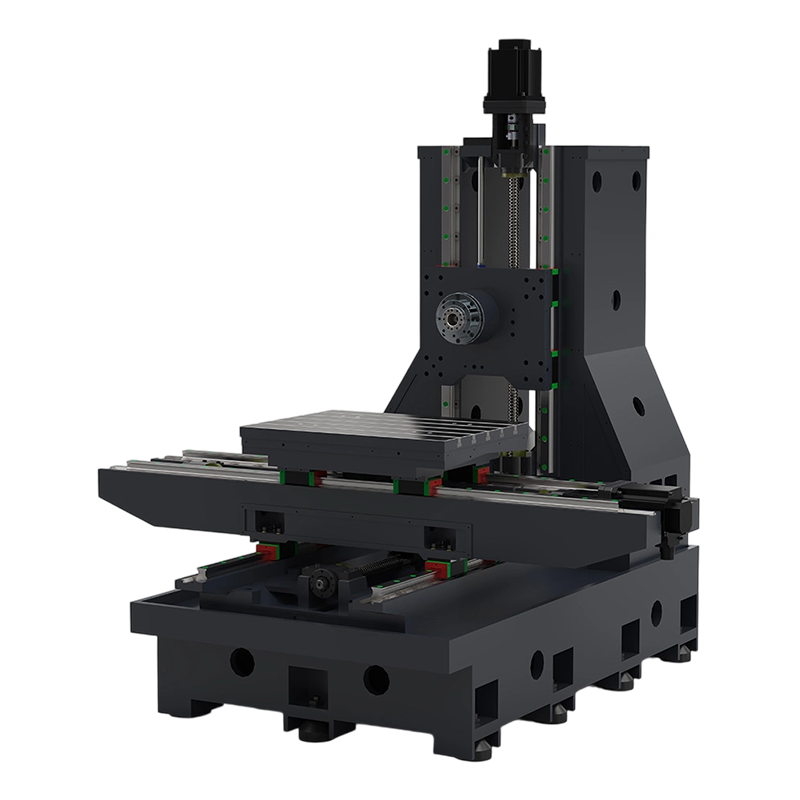 HMC80 Horizontal Machining Center for Automated Pallet CellsWith its horizontal spindle and pallet-friendly layout, this machine suits deep-bore and boxy parts, and it can expand into multi-pallet automation for medium-to-high volumes.View Product →
Gantry Machining Centers
When the workpiece exceeds about 1.5 m in X travel, the gantry takes over. The spindle rides on a bridge supported by two columns, while the workpiece stays stationary on the bed. That closed frame offers excellent rigidity across a large envelope, which is why gantries are standard equipment in large die and mold shops, aerospace structural machining, and heavy plate processing. The PL2016 gantry machining center is a typical example of a mid-size gantry with 2,000 mm of X travel.
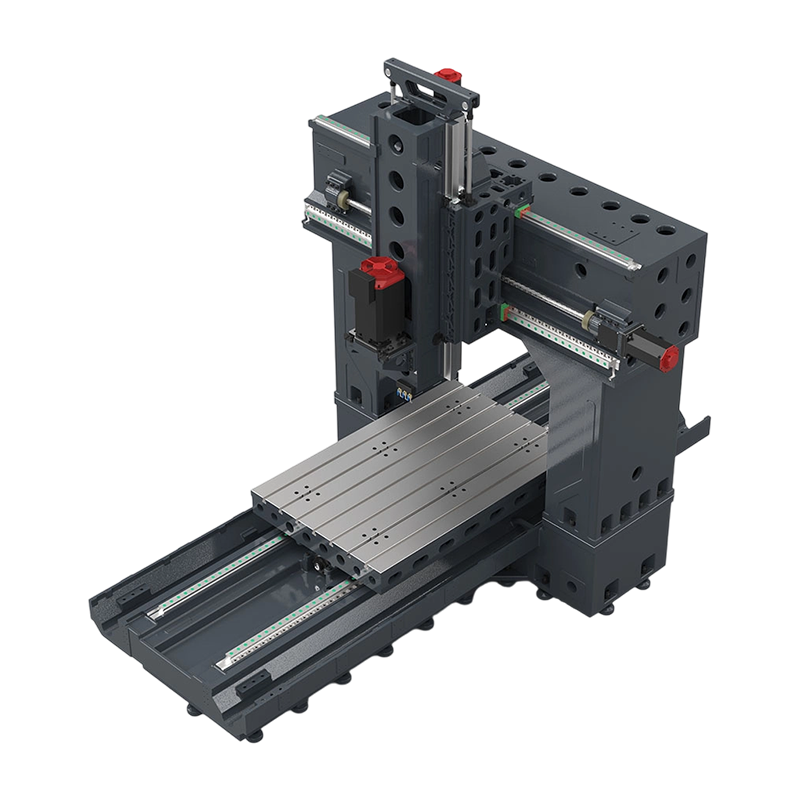 PL2016 Gantry Machining Center for Large Rigid WorkpiecesA mid-size gantry with 2000 mm X travel, built for large die, mold, aerospace, and plate work where closed-frame rigidity across a big envelope is essential.View Product →
| Criterion | VMC | HMC | Gantry |
|---|---|---|---|
| Spindle orientation | Vertical | Horizontal | Vertical |
| Best part shape | Flat parts, top-access features | Boxy parts, deep bores, multi-face machining | Large plates, big molds, long structural parts |
| Typical X travel | 600–1,380 mm | 630–1,000 mm | 2,000–2,500 mm |
| Chip evacuation | Moderate | Excellent (gravity-assisted) | Moderate |
| Automation potential | Manual or pallet | Pallet standard | Manual or rail-based |
| Relative price index | 1.0 | 1.6–1.9 | 2.2–2.8 |
The choice between these families is rarely about which one is "better." Choosing between a VMC and an HMC comes down to part geometry and batch size — our comparison of VMC vs HMC lays out the decision rules in practical terms.
Key Specifications That Decide Real-World Performance
Four specification groups determine whether a machining center earns its keep: axis travel, spindle performance, tool capacity, and the control system. They must be reviewed as a package, because a large travel with a weak spindle or a small tool magazine will bottleneck real jobs regardless of the brochure numbers.
Axis travel values correspond to catalog specifications of current New Era machining center models.
Axis travel is the first filter because it defines the maximum part size. As a practical rule of thumb, do not buy a machine whose largest part dimension is more than 70 percent of the nominal travel — you need room for workholding, clamps, and tool clearance.
| Specification | Entry VMC | HMC | Gantry |
|---|---|---|---|
| Working travel X/Y/Z | 850 × 560 × 560 mm | 800 × 700 × 700 mm | 2,000 × 1,600 × 800 mm |
| Spindle taper | BT40 | BT40 / BT50 | BT50 |
| Spindle speed range | 8,000–12,000 rpm | 6,000–8,000 rpm | 4,000–6,000 rpm |
| Tool magazine capacity | 16–24 tools | 24–40 tools | 16–24 tools |
| Typical application | Molds, brackets, plates | Housings, cylinders, cells | Large molds, aerospace plates |
Spindle speed should match your dominant material. If you cut mainly steel, an 8,000 rpm spindle is sufficient and produces better torque at lower speed than a 12,000 rpm unit; if you cut aluminum, the higher rpm range is worth the extra cost.
Matching the Machine to the Part: A Radar Comparison
Shop owners usually evaluate a machine by six criteria: setup flexibility, rigidity, footprint efficiency, automation readiness, large-part capability, and cost efficiency. Plot the three configurations and the trade-offs become visible.
Qualitative comparison — ratings reflect typical strengths of each configuration in common job shop applications.
The radar makes the compromise explicit. A VMC leads on flexibility and cost efficiency, which is why it remains the most common first machining center. An HMC leads on automation readiness and chip control — the right answer when the same part family runs for months. A gantry leads on rigidity and large-part capability, but pays a penalty in footprint and price. Choose the dimension that fails your current jobs most often, and let that be the deciding axis.
Where Machining Centers Earn Their Keep
CNC machining centers are used in every segment of precision manufacturing. The common pattern is that the higher the value of the workpiece, the larger the financial impact of a single operator error — and the stronger the case for automated, repeatable processes. Typical applications include:
- Mold and die: cores, cavities, and electrode holders, often paired with a sinker EDM for sharp internal corners and hardened details that cutters cannot reach.
- Automotive: transmission housings, brake calipers, steering knuckles, and pump bodies in mid-to-high series.
- Aerospace: structural ribs, bulkheads, and thin-walled monolithic parts where material removal is high and rigidity is critical.
- Medical and electronics: instrument housings, implant prototypes, connector molds, and heat sinks where tolerances are tight and batches are small.
In mold shops, a common and effective split is to let the machining center do 70–80 percent of the material removal and use a CNC EDM for the geometry a rotating cutter cannot produce. That combination explains why mold manufacturers tend to invest in both technologies rather than betting on one.
Cost of Ownership: What Adds Up Over Five Years
The purchase price is the most visible number, but it is the smallest useful one. Over five years, the cost of owning a machining center includes tooling and workholding, maintenance, energy, programming time, and the cost of the floor space itself. A machine that runs two shifts can justify its price in 18 to 24 months; the same machine running six hours a day may take five years. Buy capacity you can actually load.
Indicative index for comparable working envelopes — actual quotes depend on options, control system, and configuration.
Relative pricing between classes is only the start. Workholding and tooling often add 10–20 percent to the purchase price for the first job set. Energy and consumables are a smaller line, but maintenance is not: a mid-size VMC needs a spindle inspection and lubrication service on a fixed schedule, and deferring that work creates the classic failure pattern where tolerances drift and the machine fails during a production order instead of during planned downtime.
Maintenance Points That Protect the Investment
The maintenance plan that keeps a machining center accurate is not complicated, but it has to be followed on a calendar, not on a crisis schedule:
- Every shift — check coolant concentration, way lubrication, and spindle temperature; listen for unusual cutting noise.
- Weekly — inspect the tool magazine arm and clamp sensors; clean the spindle taper.
- Monthly — check backlash and axis compensation values; inspect way covers for chips.
- Quarterly — run a ballbar test to verify circularity and diagonal accuracy.
- Annually — full geometric alignment, scale calibration, and lubrication system service.
Scheduled maintenance is the cheapest insurance you can buy. A machining center kept to its calibration cycle will hold tolerance for years; one that is neglected will consume expensive tooling and rework long before it fails outright.
Frequently Asked Questions About CNC Machining Centers
Q1. What is a CNC machining center?
A CNC machining center is a computer-controlled machine tool that performs milling, drilling, boring, tapping, and reaming with an automatic tool changer, so multiple operations happen in one program cycle without manual tool changes.
Q2. What is the difference between a VMC and an HMC?
A vertical machining center has a vertical spindle and suits flat parts with features on top. A horizontal machining center has a horizontal spindle, better chip evacuation, and is the better choice for boxy parts and automated pallet cells.
Q3. How much does a CNC machining center cost?
An entry-level VMC is the most affordable way in, while HMCs cost roughly 1.5 to 1.9 times more and gantries 2.2 to 2.8 times more for comparable envelopes. Total five-year ownership cost also includes tooling, maintenance, energy, and programming.
Q4. What do 3-axis, 4-axis, and 5-axis mean?
They describe the number of controlled axes. A 3-axis machine moves X, Y, and Z. A 4-axis adds a rotary table. A 5-axis adds two rotary axes so the tool can approach the part from nearly any angle in one setup.
Q5. Can a machining center replace a CNC milling machine?
In most production work, yes, because the machining center adds automatic tool changing, faster cycle times, and better consistency. The exception is very large, long parts that need the extended envelope of a dedicated milling machine or gantry.
Q6. What is a gantry machining center used for?
Gantry machining centers are used for large workpieces such as big mold bases, aerospace structural plates, and oversized brackets where X travel exceeds about 1.5 m and the workpiece stays stationary under a moving bridge.
If you are interested in our products, please consult us.
CONTACT DETAILS
Nantong New Era Technology Co., LTD
- Five-star Industrial Park, Chongchuan District, Nantong City, Jiangsu Province, China
- TEL:+86-19851302688
- E-Mail: [email protected]
Products
Quick link
Mobile terminal
