

 русский
 عربى
عربى
Industry News
Home / News / Industry News / Five-Axis Gantry CNC: The Complete Buyer's Guide for Large-Scale Precision Machining
Five-Axis Gantry CNC: The Complete Buyer's Guide for Large-Scale Precision Machining
 2026.09.16
 Industry News
When a 3-meter aerospace frame arrives at your shop, the machining strategy is not about spindle speed alone. It is about whether one clamping can hold the tolerance across the full length of the part. A five-axis gantry CNC machine answers that question by combining a large bridge-style frame with five axes of simultaneous motion.
The conclusion first: a five-axis gantry CNC is the most practical way to machine large, complex workpieces in one setup. Fewer handlings mean better accuracy, lower fixture cost, and shorter total cycle time. The rest of this article explains how the structure works, which specifications matter, and where this machine class earns its keep.
Content
- 1 What Is a Five-Axis Gantry CNC Machine?
- 2 Five-Axis, 3+2, or Three-Axis: Matching the Motion to the Part
- 3 Key Specifications to Check Before You Buy
- 4 Where It Pays Off: Applications That Need a Five-Axis Gantry
- 5 Buying Considerations: What the Price Sheet Does Not Tell You
- 6 Common Mistakes When Specifying a Five-Axis Gantry
- 7 Frequently Asked Questions About Five-Axis Gantry CNC
- 7.1 Q1: What is a 5-axis gantry CNC machine used for?
- 7.2 Q2: How much does a 5-axis gantry CNC machine cost?
- 7.3 Q3: What is the difference between a 5-axis gantry and a 5-axis vertical machining center?
- 7.4 Q4: What accuracy can a 5-axis gantry CNC hold?
- 7.5 Q5: Can a 3-axis gantry CNC be upgraded to five-axis later?
- 7.6 Q6: What maintenance does a gantry machining center need?
What Is a Five-Axis Gantry CNC Machine?
A gantry machine is built around two floor-mounted columns that support a cross beam. The spindle head rides on the beam, while the workpiece sits on a table between the columns. Compared with a C-frame vertical machining center, the gantry design offers much higher rigidity per unit of price when the work area exceeds roughly 2 meters.
The "5-axis" part means three linear axes (X, Y, Z) plus two rotary axes. In most five-axis gantry configurations, the rotary axes are an A-axis (tilt around X) and a C-axis (rotation around Z) built into the spindle head. Some designs place rotary axes on the table instead, which is better for extremely heavy workpieces.
Understanding the difference becomes easier if you start with gantry machining center basics and then compare the head style options.
The drawing below shows the typical structural modules of a five-axis gantry CNC machine.
Five-Axis, 3+2, or Three-Axis: Matching the Motion to the Part
Not every large part needs simultaneous five-axis machining. Many prismatic parts are perfectly handled by a three-axis gantry or a 3+2 positional head. The decision depends on how many sides you need to reach, whether the surfaces are sculptured, and how often you can afford to re-clamp.
| Capability | 3-axis gantry | 3+2 positional | 5-axis simultaneous |
|---|---|---|---|
| Setups for a five-sided part | 4–6 | 2–3 | 1 |
| Angled holes and ports | Manual indexing | Yes | Yes |
| Complex 3D contouring | Limited | Stepped finish | Single-pass finish |
| Programming effort | Low | Medium | High |
| Relative investment | Lowest | Mid | Highest |
Setups required for a typical five-sided large part
Illustrative comparison; actual setup count depends on part geometry and machine configuration.
The practical takeaway: if your parts are mostly flat with occasional angled holes, a 3+2 gantry saves money and reduces programming risk. If you machine turbine blades, impellers, mold inserts with compound curves, or parts with hard-to-reach undercuts, simultaneous five-axis motion is the only way to finish them efficiently.
Key Specifications to Check Before You Buy
Work envelope and table
The distance between columns defines the maximum workpiece width. The Y-axis travel defines the depth you can reach from the front of the table, and the Z-axis travel controls the maximum part height plus tool length. Always measure the fixture into the envelope too, not just the part.
- X-axis travel: normally 3 to 12 m for gantry machines
- Distance between columns: choose 300–500 mm wider than your largest proved workpiece
- Table load: verify it with the actual workpiece plus fixture weight
Spindle performance
Spindle power and torque decide how much material you can remove per pass. A 10,000–15,000 rpm spindle with 30–60 kW covers most aluminum aerospace and mold steel applications. For titanium or Inconel, look for lower speed with higher torque and a sturdy HSK or Capto interface.
Axis configuration and rotary head
Check whether the rotary axes are a fork-type head, a swivel head, or a table-based design. Fork heads are common for simultaneous five-axis work because they allow better tool reach and less interference with the cross beam. For very heavy workpieces, a table-based design with B/C rotary axes may be the safer choice.
Control and CAM compatibility
Five-axis gantry machines depend on the CNC's ability to handle kinematic transformation, tool-center-point (TCP) control, and collision avoidance. The CAM post-processor must match the exact head kinematics. Ask the builder for the post-processor list before signing the order.
Where It Pays Off: Applications That Need a Five-Axis Gantry
A five-axis gantry CNC is not a general-purpose machine. It earns its cost when the work envelope is large, the part is complex, and re-clamping is expensive or risky. Three application groups dominate the demand.
Aerospace and defense
Monolithic aluminum frames, wing ribs, spar caps, and bulkheads combine long dimensions with thin walls and five-sided machining. The gantry structure supports the long X-axis while the rotary head reaches angled fastener pockets without relocating the part. One setup also reduces geometric error between features.
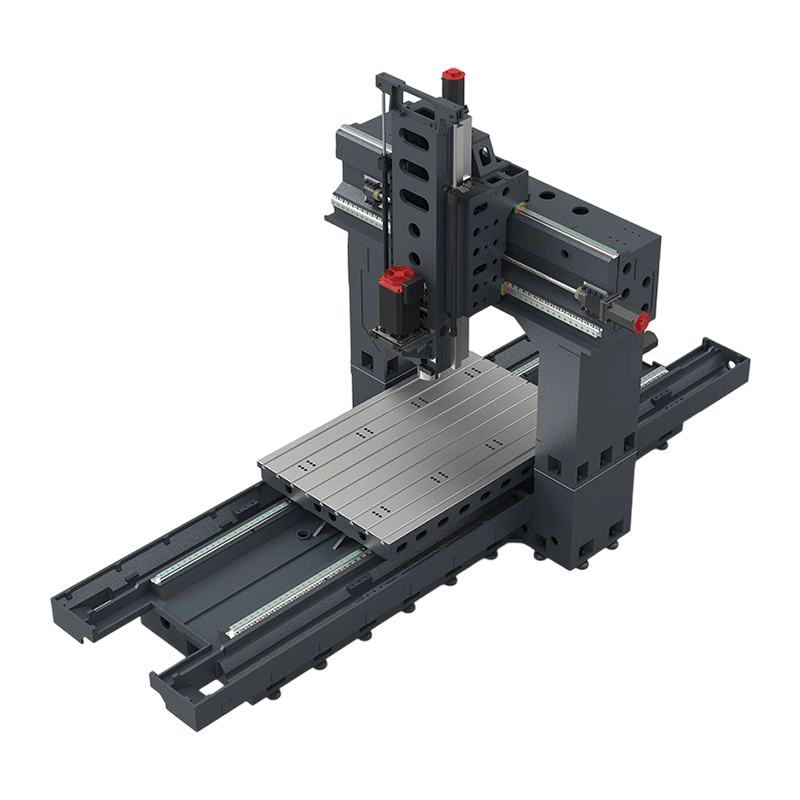 PL2518 Gantry Machining Center for Large Structural PartsThis five-axis gantry machine suits long aluminum components and broad die surfaces, offering a large work envelope and enhanced spindle output. Its accessible table and smart controls reduce setup time while improving finishing efficiency.View Product →
Large mold and die manufacturing
Automotive outer panel dies, large plastic injection molds, and die-casting tooling require continuous surface finishing over broad areas. A five-axis gantry keeps the tool perpendicular to the surface, producing a better finish and cutting much less hand polishing. The same machine can handle graphite electrodes when equipped with a suitable spindle and dust extraction.
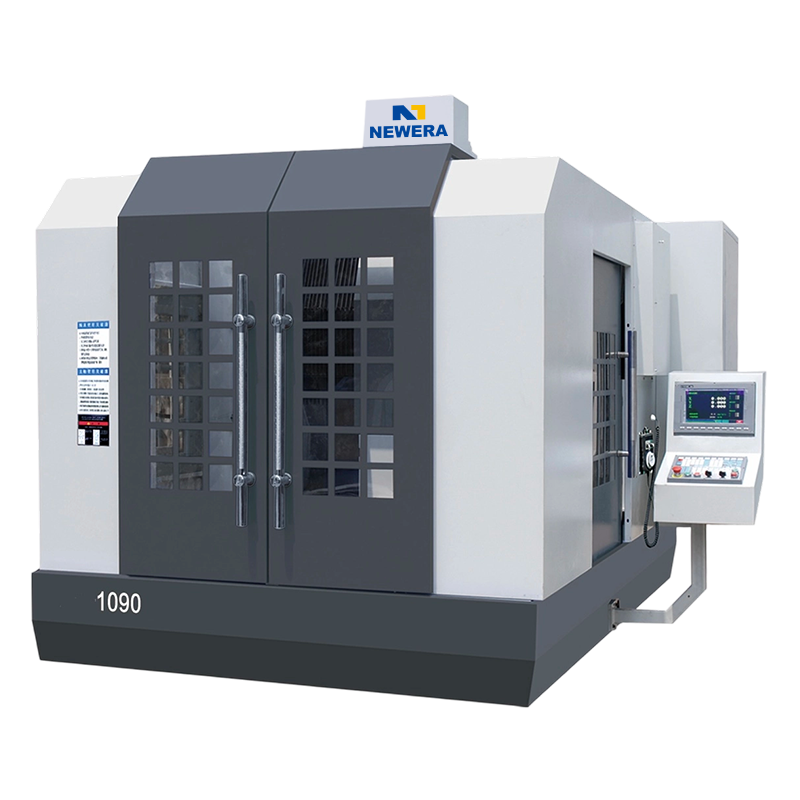 NE1090 CNC Gantry Milling Machine for Oversized WorkpiecesBuilt for large molds and casings beyond vertical machining center limits, this gantry mill uses cast iron construction and high-speed ceramic bearings for rigidity and accuracy. Its deep Z-axis reach handles cavities other machines cannot access.View Product →
Energy, railway, and heavy equipment
Wind turbine blade molds, gas turbine casings, bogie frames for railcars, and large gearboxes frequently exceed the limits of a vertical machining center. In these cases the gantry’s open table and large Z-axis allow the spindle to access deep cavities that a C-frame machine simply cannot reach.
Common Mistakes When Specifying a Five-Axis Gantry
- Focusing only on X/Y/Z travel and ignoring the height of the cross beam. A part may fit on the table but still collide with the beam when the head tilts.
- Forgetting that rotary axes need torque, not only speed. Many five-axis heads look fast on paper but cannot hold a heavy tool in an angled cut.
- Underestimating the programming learning curve. Five-axis simultaneous machining demands CAM skills, setup discipline, and simulation habits that three-axis shops do not have.
- Neglecting tool length and toolholder clearance. The rotary head adds physical size, which changes minimum reach and the lowest Z position.
- Matching the spindle to the material only partially — without considering the fixture and damping. Long thin walls on large parts can create chatter that no spindle upgrade can cure.
Frequently Asked Questions About Five-Axis Gantry CNC
Q1: What is a 5-axis gantry CNC machine used for?
It is used for large workpieces that need five-sided or contour machining in one setup — typically aerospace structural parts, large mold and die blocks, and energy components. The gantry frame provides the rigidity needed to hold accuracy across long travels.
Q2: How much does a 5-axis gantry CNC machine cost?
The price depends on work envelope, spindle power, rotary-axis configuration, and control system. No two quotes are the same. The right approach is to specify your largest part and ask the manufacturer to configure the machine around it.
Q3: What is the difference between a 5-axis gantry and a 5-axis vertical machining center?
A VMC has a C-frame with the spindle mounted above the table in a single cast column. A gantry has two columns supporting a cross beam, which increases stiffness and allows much longer X-axis travel. The gantry is usually preferred when the part exceeds 2 meters.
Q4: What accuracy can a 5-axis gantry CNC hold?
Accuracy depends on compensation, thermal control, and scale feedback. A properly specified machine can hold positioning in the range of several hundredths of a millimeter, which is why it fits mold and precision manufacturing. The manufacturer should provide accuracy data measured across the full volume, not just at one point.
Q5: Can a 3-axis gantry CNC be upgraded to five-axis later?
Retrofitting a rotary head or table is possible when the control system and drives are compatible, but the engineering cost often approaches that of a new machine. Most companies choose the five-axis version when the 3-axis machine is no longer enough.
Q6: What maintenance does a gantry machining center need?
Maintenance focuses on guideway lubrication, scale feedback cleaning, spindle cooling, and checking the rotary head seals. Because a gantry has a long X-axis, regular leveling checks are also important to prevent accuracy drift over time.

If you are interested in our products, please consult us.
CONTACT DETAILS
Nantong New Era Technology Co., LTD
- Five-star Industrial Park, Chongchuan District, Nantong City, Jiangsu Province, China
- TEL:+86-19851302688
- E-Mail: [email protected]
Products
Quick link
Mobile terminal
