

 русский
 عربى

Industry News
Home / News / Industry News / A Guide to CNC Machining for Aerospace: Tolerances, EDM and Machine Tool Choices
A Guide to CNC Machining for Aerospace: Tolerances, EDM and Machine Tool Choices
 2026.09.30
 Industry News
A job shop is quoting a titanium bracket: Ti-6Al-4V, 240 mm long, two bearing bores held to ±0.010 mm, a 0.8 mm-wide seal groove that must finish at Ra 0.4 µm, and a first article inspection report delivered together with the pilot batch. The milling centre that made the shop's general engineering work profitable will not automatically make this job profitable.
Aerospace machining is decided by three things long before spindle power enters the conversation: how steadily a machine holds size through an eight-hour thermal cycle, whether the shop owns a process that can produce a sharp internal corner without a cutter radius, and whether the paperwork can survive a customer audit. Get those right and the job is winnable. Get them wrong and the first article fails, the fixture is scrapped, and the customer quietly moves to the next supplier.
Content
- 1 What Makes Aerospace Machining Different
- 2 Where Milling Stops and EDM Starts
- 3 Machine Tool Specifications That Actually Matter
- 4 Large Airframe and Fixture Work: Gantry and Horizontal Platforms
- 5 High-Mix Aerospace Shops: The Vertical Machining Centre Choice
- 6 Documentation Buyers Ask For
- 7 Cost, Lead Time and the Warm-Up Question
- 8 Aerospace CNC Machining: Common Questions
- 8.1 Q1. What tolerance can CNC machining hold for aerospace parts?
- 8.2 Q2. Why is a CNC EDM die sinking machine used for aerospace components?
- 8.3 Q3. Is titanium or Inconel harder to machine?
- 8.4 Q4. What quality documents do aerospace buyers expect?
- 8.5 Q5. Can a vertical machining centre handle aerospace work, or do I need five axes?
- 8.6 Q6. How long does it take to bring a CNC EDM machine into production?
What Makes Aerospace Machining Different
Aerospace parts are not simply "tighter". They differ in material, geometry and evidence, and each one changes the machine you should buy.
Start with material. Ti-6Al-4V conducts heat at roughly 7 W/m·K, against about 200 W/m·K for aluminium, so most of the heat generated at the cutting edge stays in the tool and the workpiece instead of leaving with the chip. Inconel 718 work-hardens the moment a tool rubs rather than cuts. Neither behaviour is cured by a larger spindle motor; both are managed by rigidity, coolant delivery and the right finishing process.
| Material | What makes it awkward | Process that usually finishes the feature |
|---|---|---|
| Ti-6Al-4V | Low thermal conductivity keeps heat at the edge; thin walls deflect under load | Carbide roughing, then five-axis finishing or sinker EDM in deep slots |
| Inconel 718 | Work hardens under rubbing; tool life collapses at low surface speed | Ceramic or carbide milling; sinker EDM for narrow slots and cooling holes |
| 15-5PH stainless | Gummy in the annealed state, hard after ageing | Machine before ageing, or EDM after heat treatment |
| Tool steel 48-52 HRC | Rapid cutter wear and chatter once hardened | Sinker EDM for cavities, ribs and sharp internal corners |
| Aluminium 7075 / 2024 | Cuts easily but moves after roughing due to residual stress | Rough, stress-relieve, then finish on a temperature-stable machine |
Geometry is the second difference. Aerospace work is full of deep pockets six to eight times deeper than the cutter diameter, ribs under 1.5 mm wide, and internal corners drawn with a radius of 0.3 mm or less. That last detail alone decides whether the part leaves a milling machine or an EDM.
Evidence is the third. Every flying part needs traceability: heat lot, machine, operator, tool life, inspection result. A shop that cannot produce that record on request is not really in the aerospace supply chain, regardless of how good its surface finish looks.
Typical tolerance bands by operation (mm)
Bar length is proportional to the tolerance band, so shorter bars mean tighter control. Ranges reflect common shop-floor practice and must be verified against your own capability study.
Where Milling Stops and EDM Starts
The practical rule is simple: the smallest cutter you can run without breaking sets your internal corner radius. Below roughly 0.5 mm, in hardened material, or where a burr is unacceptable, sinker EDM takes over.
Sinker EDM removes material by controlled spark erosion with no cutting force at all. That means no deflection on a 0.8 mm rib, no tool pressure on a thin flange, and no burr on a fuel gallery edge. The trade-off is a recast layer, usually in the range of 1 to 20 µm, which is removed with fine finishing passes or a light abrasive operation. If your drawing does not specify the recast allowance, the electrode programme cannot be optimised for it.
In aerospace production, EDM is normally found on turbine blade cooling holes, fir-tree root forms, fuel injector orifices, seal slots and the tooling that produces composite and rubber components. It is also the standard route for hardened die inserts once the cavity detail drops below what a 3 mm cutter can reach.
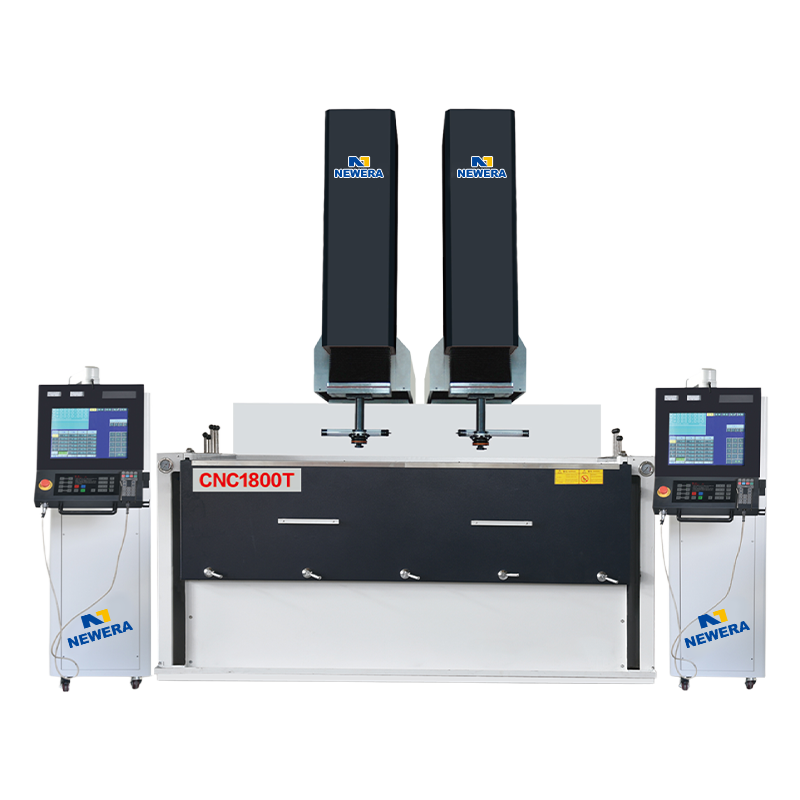
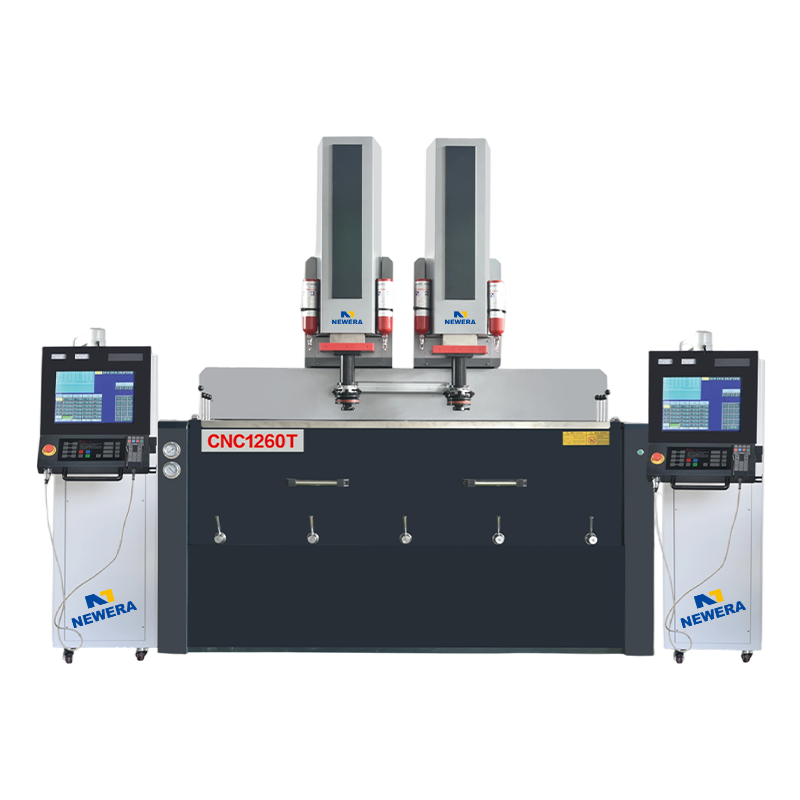
 CNC 1260 EDM Die Sinking Machine/Sinker EDMCNC1260 double heads die-sinking EDM machine is a high-precision, specialized machining center. Designed and developed with the needs of its users in mind, it boasts a...View Product →
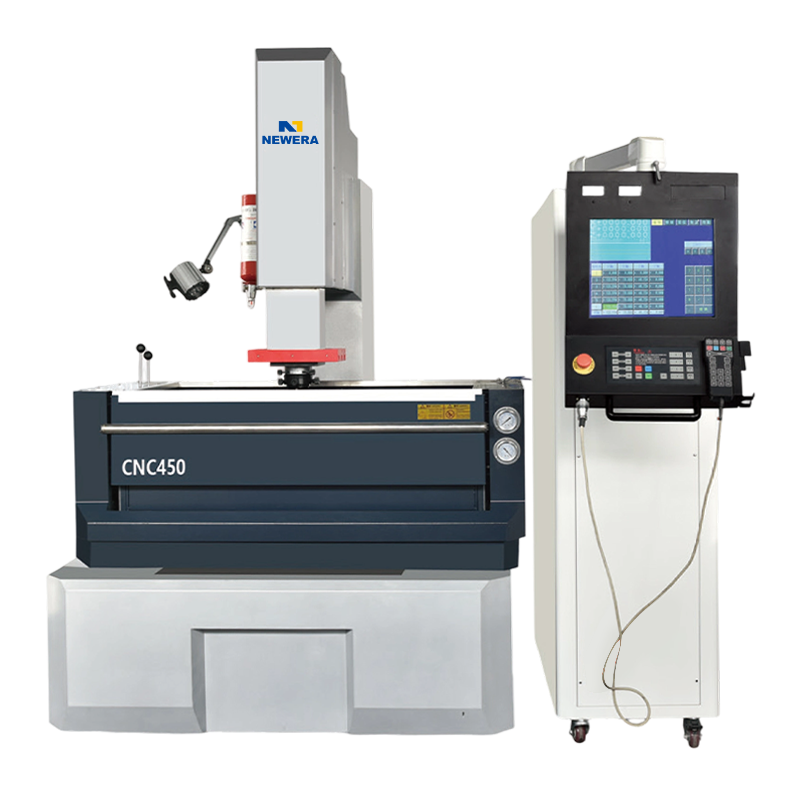
When a shop moves from a manual ZNC machine to a full CNC sinker, the change is mostly about orbit control and repeatability. A CNC sinker can run programmed planetary orbits, hold a spark gap consistently across a deep cavity, and store the settings for a job that returns next year. That repeatability, not raw speed, is what keeps aerospace tooling work inside tolerance across a batch. If you are comparing control levels for the first time, this sinker EDM selection guide walks through the differences between ZNC, PNC and full CNC platforms.
Machine Tool Specifications That Actually Matter
Once the process mix is settled, the machine specification follows from four requirements. Everything else is a preference.
Thermal stability and growth compensation
A spindle that grows 20 µm over the first two hours will produce parts that drift out of tolerance even if the positioning accuracy on the datasheet is perfect. Look for cooled spindle housings, temperature sensors in the structural loop, and a control that can apply growth compensation. A 30-minute warm-up programme before the first cut is standard practice, not optional.
Rigidity, damping and guideway choice
Box ways with hand-scraped contact surfaces damp vibration better than linear roller guides and are the safer choice for heavy interrupted cuts in titanium and Inconel. Roller guides are faster and need less maintenance, which suits aluminium detail work. Ask for the structural damping data, not just the rapid traverse rate.
Feedback, probing and control
Glass scales on all linear axes, direct measurement of the rotary table, and a spindle probe for in-process verification turn a good machine into a reliable one. On a titanium part with a thin floor, measuring the feature while the part is still clamped prevents the most expensive kind of scrap.
Coolant, chip and fire management
Titanium fines are combustible. High-pressure through-spindle coolant, correct chip evacuation and a clean chip conveyor are safety equipment, not housekeeping. Deep-pocket work in aluminium also needs coolant pressure high enough to clear chips, otherwise the tool recuts them and the wall finish fails inspection.
Isometric view of a sinker EDM layout: the column carries the Z-axis head, the ram holds the electrode, and the workpiece sits inside the dielectric tank on the bed.
Large Airframe and Fixture Work: Gantry and Horizontal Platforms
Structural parts and assembly fixtures bring a different problem: the part is bigger than the machine's travel. A gantry machining centre solves this by carrying the spindle on a bridge, so the table stays fixed and heavy workpieces never have to move. For long stringers, wing ribs and drilling fixtures, that arrangement removes a whole class of positioning error.
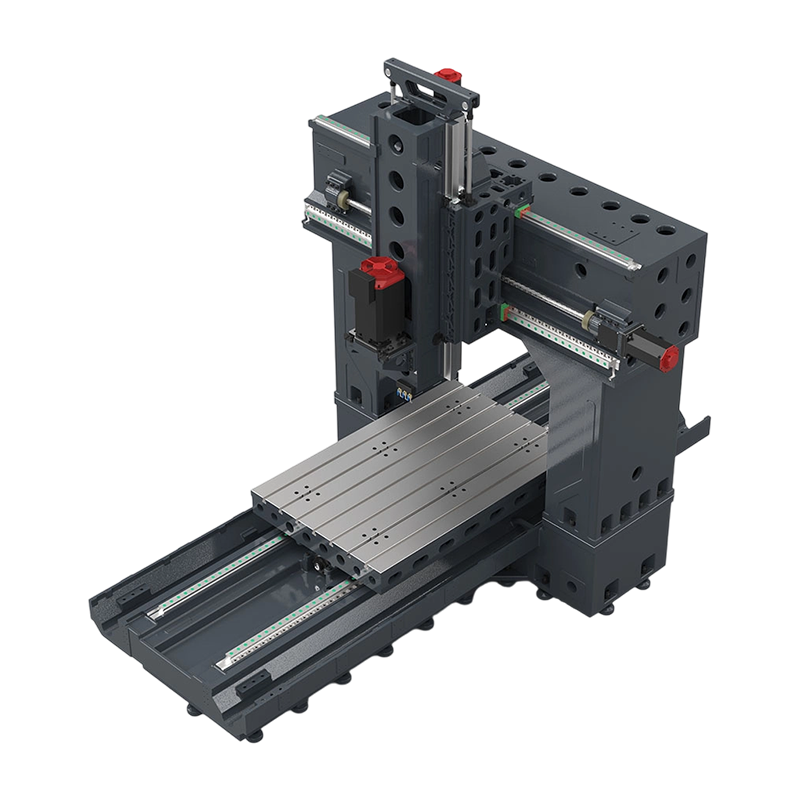 PL2016 Gantry Machining CenterPursuit of Usability Employs a sophisticated cover design and is designed taking into account the accessibility to the table and workpiece handling with a crane. Other...View Product →
Horizontal machining centres are the other half of the answer. With a tombstone fixture and pallet changer, a horizontal machine can cut four faces of a prismatic part in one setup, and gravity helps chips fall clear instead of recirculating in a deep pocket. For high-volume aluminium housings and brackets, that chip behaviour alone often decides the cycle time.
High-Mix Aerospace Shops: The Vertical Machining Centre Choice
Most subcontractors do not run one part for a year. They run thirty different parts a month, and the vertical machining centre becomes the backbone of the shop. Here the priorities shift toward fast setup, reliable tool breakage detection and a control that stores proven programmes without fuss.
A high-performance VMC with a box-way Z axis, cooled spindle and generous rapid rates will handle titanium and hardened stainless for small structural details, while an economical machine can cover aluminium brackets and fixture plates at a much lower capital cost. Splitting the work between the two is usually smarter than buying one machine that is mediocre at both.
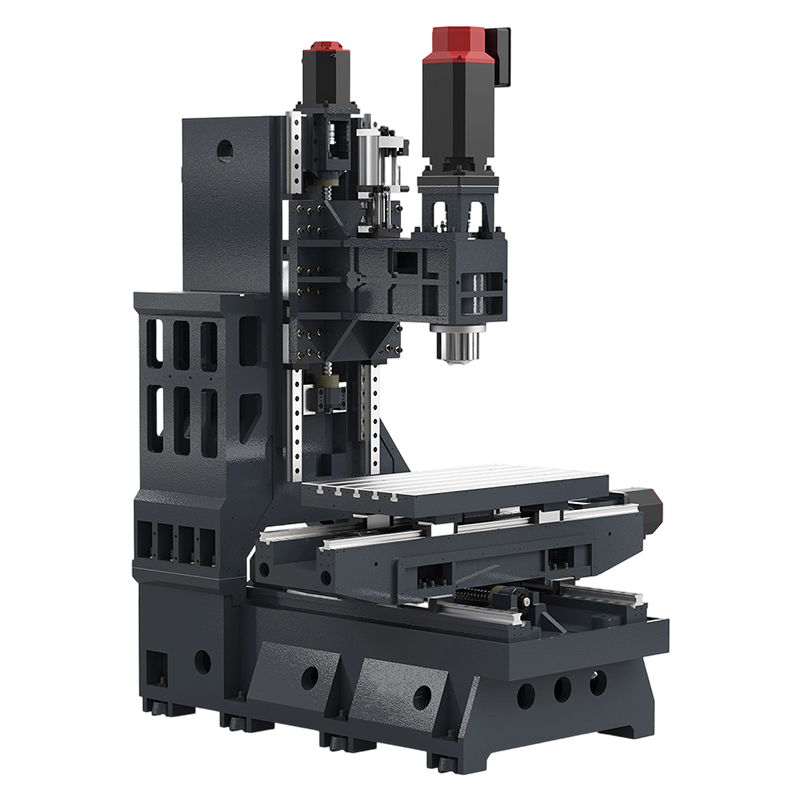 VF85 High Performance Vertical Machining CenterPursuit of Usability Employs a sophisticated cover design and is designed taking into account the accessibility to the table and workpiece handling with a crane. Other...View Product →
Whatever the model, insist on a spindle probe and a tool setter. On a mixed-part schedule, the time saved on setup is worth more than the last few metres per minute of rapid speed.
Documentation Buyers Ask For
Product quality gets you the first order. Documentation gets you the second one. Aerospace customers typically ask for material certificates with heat lot traceability, first article inspection reports, CMM or gauge records, tool life logs, and calibration certificates for every measuring instrument used on the job. AS9100 is the quality management standard most aerospace buyers require from their supply chain, and special processes are frequently expected to be accredited under NADCAP. Machine tools themselves do not carry these approvals, but the shop's ability to hold capability on those machines is what the auditor will examine.
For a machine tool builder, the useful contribution is repeatability data and a control that makes the record easy to keep. New Era Technology, a Nantong-based builder with more than twenty years in CNC machine tools, publishes the machine platforms that cover this range, from die-sinking EDM through machining centres to grinding machines — see the full machine tool range.
Cost, Lead Time and the Warm-Up Question
The most common argument in an aerospace shop is whether a warm-up cycle is worth an hour of spindle time a day. The answer is in the drift curve: an uncompensated spindle grows quickly in the first hour and then flattens. Parts that are cut before that plateau will sit several micrometres away from parts cut after it.
Illustrative thermal growth of an uncompensated spindle during warm-up; actual values depend on spindle design, coolant and ambient temperature.
Beyond the machine price, budget for the items that decide whether aerospace work is profitable: a temperature-controlled room if the tolerances are genuinely tight, a CMM or at least a calibrated height gauge, spare electrodes and fixtures, and a service response agreement that actually states a response time. A machine that is down for three weeks costs more than the difference between two purchase quotes.
Aerospace CNC Machining: Common Questions
Q1. What tolerance can CNC machining hold for aerospace parts?
General milling typically holds ±0.05 to ±0.10 mm, precision boring on a rigid VMC reaches ±0.010 mm, and sinker EDM with fine finishing passes reaches ±0.005 mm. Anything tighter usually moves to grinding or lapping, and every figure must be proven by a capability study on your own machine.
Q2. Why is a CNC EDM die sinking machine used for aerospace components?
EDM cuts by spark erosion with zero cutting force, so it can produce sharp internal corners, deep narrow slots and burr-free edges in hardened alloys. It is the standard route for cooling holes, fir-tree forms and hardened tooling inserts where milling leaves a radius or a burr.
Q3. Is titanium or Inconel harder to machine?
Both are difficult for different reasons. Titanium carries heat into the tool because of its low thermal conductivity and deflects easily on thin walls. Inconel 718 work-hardens when the tool rubs and destroys edges quickly at low surface speeds. Tooling, coolant pressure and rigidity matter more than spindle power in both cases.
Q4. What quality documents do aerospace buyers expect?
Material certificates with heat lot traceability, first article inspection reports, dimensional inspection records, tool life logs, and calibration certificates for measuring equipment. Most buyers also require their suppliers to operate under AS9100, and special processes are frequently expected to hold NADCAP accreditation.
Q5. Can a vertical machining centre handle aerospace work, or do I need five axes?
A three-axis VMC covers brackets, housings, fixture plates and many structural details very profitably. Five-axis becomes necessary when the part has contoured surfaces, undercut features or needs multiple faces without repositioning, such as impellers and complex ribs.
Q6. How long does it take to bring a CNC EDM machine into production?
Installation and levelling usually take a few days, then the electrode and orbit programme has to be proven on a test workpiece before production starts. Allow several weeks from delivery to a qualified process, and longer if the work requires first article inspection and customer approval.
If you are interested in our products, please consult us.
CONTACT DETAILS
Nantong New Era Technology Co., LTD
- Five-star Industrial Park, Chongchuan District, Nantong City, Jiangsu Province, China
- TEL:+86-19851302688
- E-Mail: [email protected]
Products
Quick link
Mobile terminal
