

 русский
 عربى

Industry News
Home / News / Industry News / EDM Discharge Machining Explained: Process, Tooling and Machine Selection
EDM Discharge Machining Explained: Process, Tooling and Machine Selection
 2026.10.14
 Industry News
A 0.6 mm inside corner in a hardened H13 mold insert forces a small end mill into 52 HRC steel, and that is a tool-breaking job most shops would rather decline. EDM discharge machining sidesteps the problem completely: the electrode never touches the workpiece with a cutting edge, and metal is removed by controlled electrical sparks instead of mechanical shear.
That single difference explains everything that follows, including why EDM cuts hardened tool steel, carbide and nickel alloys with the same logic, why it is slower than milling, and why the control level of a die-sinker (ZNC, PNC or CNC) usually matters more than the size of the worktable.
Content
- 1 What EDM Does That Milling and Grinding Cannot
- 2 How a Spark Removes Metal
- 3 Sinker, Wire and Small-Hole EDM: Three Processes, Three Jobs
- 4 What Decides the Result: Electrode, Generator, Flushing
- 5 ZNC, PNC and CNC: Matching the Control Level to the Job
- 6 What to Check Before You Order
- 7 Frequently Asked Questions About EDM Discharge Machining
What EDM Does That Milling and Grinding Cannot
Conclusion first: choose EDM when the workpiece is electrically conductive, harder than roughly 45 HRC, and shaped with cavities or corners a rotating cutter cannot reach. That combination covers most mold inserts, die blocks, extrusion tooling and hardened aerospace parts.
Milling and grinding run into the same three walls:
- Hardness: carbide tooling handles roughly 45 HRC in routine production. Above that, tool life becomes unpredictable and cost per part climbs steeply.
- Geometry: a 0.6 mm internal corner requires a 1.2 mm cutter, which is fragile even in soft steel and unusable in hardened stock.
- Force: thin ribs and deep slots deflect under the cutting load, so tolerances drift long before the tool wears out.
EDM removes all three constraints because erosion is thermal rather than mechanical. Machining force on the workpiece is close to zero, hardness stops being the deciding variable, and any shape an electrode can physically reach can be produced, including blind cavities with sharp internal corners.
The trade-offs are real: lower metal removal rates than rough milling, a recast layer that sometimes has to be removed afterwards, consumable electrodes, and dielectric fluid to manage and filter.
Indicative hardness ceilings in normal production. For EDM the true limit is electrical conductivity, not hardness.
How a Spark Removes Metal
Every discharge lasts a few microseconds and repeats the same four steps. The servo advances the electrode until the gap is small enough; the dielectric breaks down and a plasma channel forms; the channel melts and vaporises a small volume of workpiece and electrode material; the current is switched off, the plasma collapses, and the next pulse carries the debris out of the gap.
Because the servo constantly re-establishes that gap, the electrode never touches the workpiece. That is why a die-sinker can burn a cavity into a hardened block without leaving the tool marks a milling cutter would produce.
Two practical consequences follow. First, the gap is a working dimension rather than an error, so the electrode has to be undersized by roughly the gap width for the finishing pass. Second, electrode wear is unavoidable, because part of every discharge energy always goes into the tool.
Schematic of a die-sinking EDM gap: the ram feeds a shaped electrode through flooded dielectric, and each pulse erodes a small volume of metal.
Sinker, Wire and Small-Hole EDM: Three Processes, Three Jobs
EDM discharge machining is not one process. Three variants cover almost all industrial work, and the choice between them is decided by geometry rather than by material.
| Variant | Tool electrode | Typical geometry | Main limitation |
|---|---|---|---|
| Die-sinking (ram) EDM | Shaped copper, graphite or copper-tungsten electrode | Blind 3D cavities, ribs, sharp internal corners, engraving | One electrode per shape unless orbiting is used; slower than wire on through profiles |
| Wire EDM | Brass or coated wire, typically 0.1 to 0.3 mm | Through profiles, punches and dies, extrusion dies, tapered cuts | Through-cuts only; workpiece must be conductive; limited 3D shaping |
| Small-hole EDM | Rotating tubular electrode | Start holes for wire EDM, cooling channels, deep small holes | Restricted to small diameters; slow when large volumes are removed |
Die-sinking is the variant most mold and die shops depend on, because cavities, ribs and shut-off edges rarely pass straight through the block. If you are new to the process, this shop-floor overview of what die-sinking EDM is used for covers the same ground in more detail.
What Decides the Result: Electrode, Generator, Flushing
Three variables set the outcome on any die-sinker, regardless of brand:
- Electrode material. Copper holds fine detail and produces the best surface finish; graphite removes material faster and wears less; copper-tungsten is reserved for the smallest features and for cutting carbide.
- Generator settings. Discharge energy controls removal rate and surface finish, and the two move in opposite directions: more energy burns faster and rougher.
- Flushing. Dielectric flow through or around the gap clears debris. Weak flushing causes arcing, unstable burning and taper on the cavity walls.
The finish you can reach is really a decision about time. A cavity that takes half an hour to rough can take several hours to bring to a mirror finish, because the final passes use low energy and orbiting rather than brute force.
Typical Ra values quoted for die-sinking EDM stages. Finer finishes need lower discharge energy and longer orbiting time.
ZNC, PNC and CNC: Matching the Control Level to the Job
The control level decides how much of the process runs automatically, and on a die-sinker of a given worktable size it is the single biggest price driver. A manufacturer such as Nantong New Era Technology splits its sinker range into three control families for exactly that reason.
ZNC: depth control for repetitive work
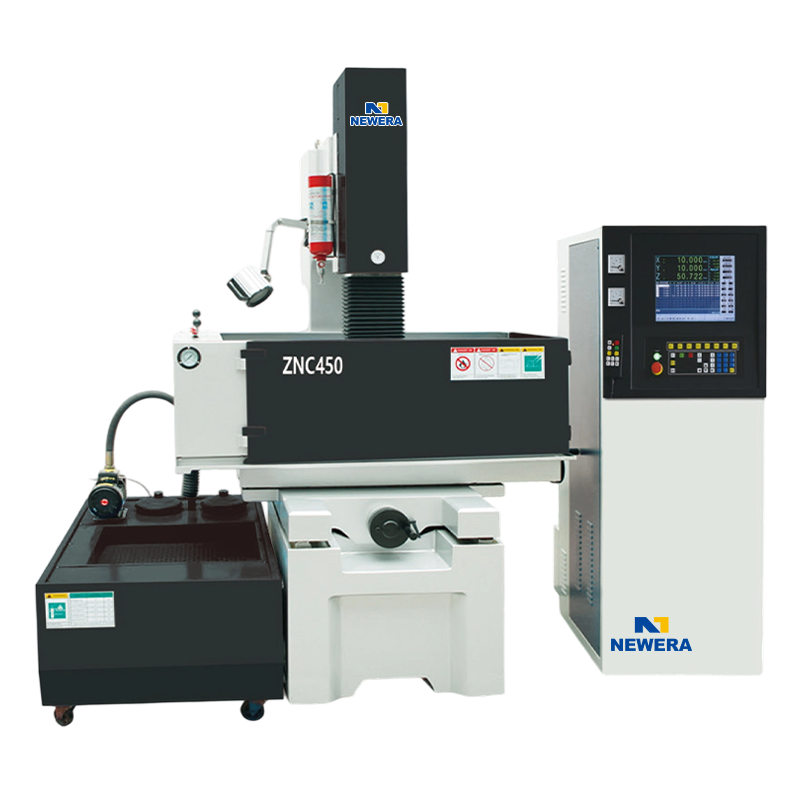
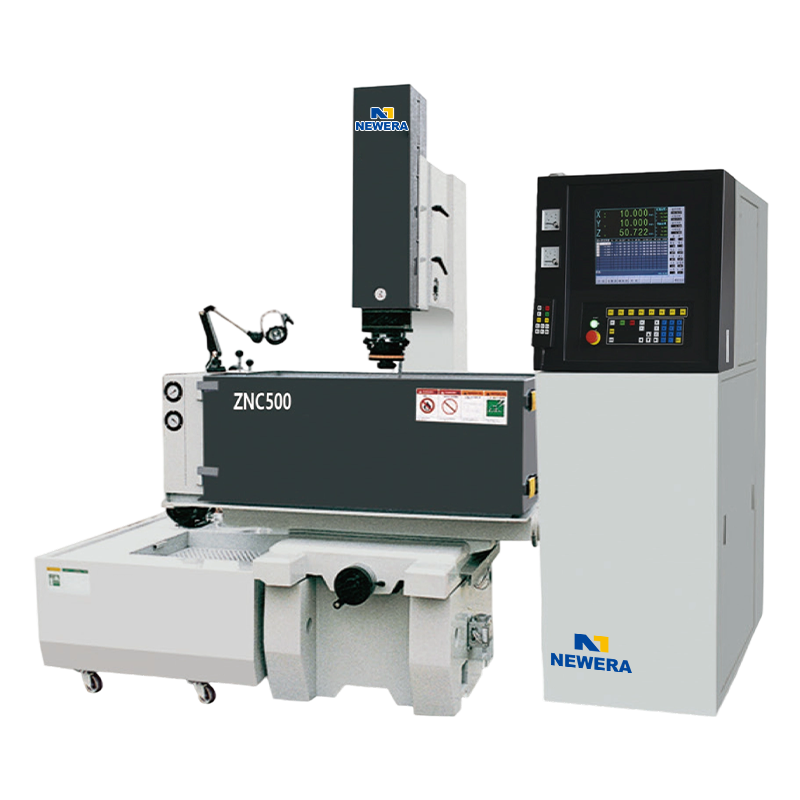
A ZNC sinker drives the Z axis with a servo and a numerical depth setting while X and Y are positioned manually. It fits work where the electrode shape is fixed, the depth is known and the same job repeats. Setup is quick, the control is easy to train on, and the machine earns its keep in tool rooms where one operator runs several jobs. The ZNC-550 sits in the middle of that family, between the compact ZNC-450 and the larger ZNC-700.
 ZNC 550 EDM Die Sinking Machine/Sinker EDMOptional: EDM Control CabinetView Product →
PNC: programmed depth steps
A PNC sinker adds programmable Z-axis steps, so a single electrode can run several depth levels or a sequence of roughing and finishing passes without an operator standing at the control. That suits multi-cavity molds and small batch production where one electrode is used at different depths. Models run from the PNC-350 up to the PNC-550.
 PNC 500 EDM Die Sinking Machine/Sinker EDMOptional: PNC Tungsten Steel Electric Box (DC)View Product →
CNC: orbiting, multi-axis and unattended running
A CNC sinker controls X, Y and Z, and often a C axis, under full numerical control. That enables orbiting, which lets one undersized electrode rough and finish a cavity, improves flushing and cuts the electrode count on a complex mold. It also allows automatic electrode changing and lights-out operation, which is where the higher purchase price is recovered on multi-cavity work. The CNC sinker range runs from the CNC-450 up to the CNC-1800.
 CNC 850 EDM Die Sinking Machine/Sinker EDMOptional: CNC Electrical Box (AC/Japan Panasonic servo motor)View Product →
What to Check Before You Order
Five questions separate a machine that fits your work from one that sits idle:
- Worktable and travel. Measure your largest electrode, not your largest part, and confirm the electrode can reach the cavity position with clearance to spare.
- Generator range. Ask how many discharge circuits the machine has and what Ra it holds in production, not what the brochure claims.
- Flushing options. Through-electrode, side flushing and vacuum assist suit different cavity shapes; one method alone will limit you.
- Control and training. A CNC sinker needs an operator who can program orbits and electrode offsets; a ZNC does not.
- Support. Spare parts, electrode material sourcing and on-site commissioning matter more on EDM than on a milling machine, because generator behaviour is machine-specific and rarely fixed locally.
Frequently Asked Questions About EDM Discharge Machining
Q1. What is EDM discharge machining used for?
It machines conductive materials that are too hard or too intricate for milling: mold cavities, die inserts, extrusion dies, deep small holes and hardened aerospace parts.
Q2. What materials can be machined by EDM?
Any electrically conductive material, including hardened tool steel, carbide, titanium, Inconel, aluminium and copper. Ceramics and most plastics cannot be EDM machined.
Q3. What is the difference between sinker EDM and wire EDM?
Sinker EDM burns a shaped electrode into the workpiece to create blind 3D cavities. Wire EDM cuts a through profile with a travelling wire, so it is faster for punches, dies and any cut that passes through the part.
Q4. Can an EDM machine cut steel after heat treatment?
Yes, and that is its main advantage. Hardening is normally done before EDM, so the cavity is burned into the final hardness and no distortion from a second heat treatment is introduced.
Q5. Which electrode material is best for sinker EDM?
Graphite for fast roughing with low wear, copper for fine detail and the best surface finish, and copper-tungsten for the smallest features or when machining carbide.
Q6. How do I choose between a ZNC, PNC and CNC EDM machine?
Match the control to the work. Repetitive single-depth jobs suit ZNC, programmed multi-depth batches suit PNC, and complex molds needing orbiting, several electrodes or unattended running justify CNC.
If you are interested in our products, please consult us.
CONTACT DETAILS
Nantong New Era Technology Co., LTD
- Five-star Industrial Park, Chongchuan District, Nantong City, Jiangsu Province, China
- TEL:+86-19851302688
- E-Mail: [email protected]
Products
Quick link
Mobile terminal
