

 русский
 عربى

Industry News
Home / News / Industry News / CNC Gantry Machine for Precision Machining: A Practical Selection Guide
CNC Gantry Machine for Precision Machining: A Practical Selection Guide
 2026.11.11
 Industry News
A 2.5 m mold base will not fit on a typical 40-taper vertical machining center, and even if it did, the table would be carrying several tonnes while the spindle tries to hold a tolerance across a long stroke. That is the point where a CNC gantry machine for precision machining starts to make sense. The structure is different, the load path is different, and the purchase risk is different.
The short answer: choose a gantry when part size, part weight, and overhead access dominate the process. Stay with a vertical machining center when small parts need fast chip-to-chip cycles and a compact footprint. Precision is not guaranteed by the gantry layout alone; it comes from structural stiffness, thermal behavior, geometry over the full stroke, and an acceptance test that proves the machine after installation.
Content
- 1 When a CNC gantry machine beats a vertical machining center
- 2 The precision chain: structure, thermal behavior, and geometry
- 3 Matching the machine to the part, not the brochure
- 4 Specification checks that protect the purchase
- 5 Foundation, workholding, and installation risks
- 6 A practical selection sequence
- 7 Frequently asked questions
- 7.1 Q1. What is a CNC gantry machine used for?
- 7.2 Q2. How much floor space does a gantry machining center need?
- 7.3 Q3. Can a gantry machine hold precision over the full stroke?
- 7.4 Q4. What foundation is required for a double-column machining center?
- 7.5 Q5. Gantry machining center vs vertical machining center for large molds?
- 7.6 Q6. What acceptance tests should I request?
When a CNC gantry machine beats a vertical machining center
A gantry machining center is not simply a larger vertical machining center. On a double-column gantry, the workpiece sits on a fixed table while the spindle travels on a cross rail between two columns. That arrangement spreads cutting loads across a wide base and gives the operator access to large parts from above. On a traditional vertical machining center, the table moves in X and Y, which is efficient for smaller parts but becomes a mass-handling problem as workpiece size grows.
| Decision factor | CNC gantry machine | Vertical machining center |
|---|---|---|
| Part envelope | Suits long, wide or tall parts that need a fixed table and overhead access. | Best for small to medium parts within the table travel. |
| Part weight | Foundation and table design can support heavy mold bases and frames. | Moving-table mass becomes a limit as workpiece weight rises. |
| Floor space | Usually larger footprint; needs planned crane and foundation access. | More compact and easier to integrate into a cell. |
| Small-part cycle time | Often slower for small, high-volume parts because of axis mass and travel. | Generally faster for small parts and quick changeovers. |
| Setup for large molds | Fixed table and overhead spindle reduce re-fixturing on large workpieces. | Requires careful table loading and may limit access to deep cavities. |
| Foundation sensitivity | High; leveling and isolation affect geometry and surface finish. | Moderate; still needs a stable slab, but mass and height are lower. |
If the part envelope is the main constraint, start with the gantry machining center range and compare table size, rail spacing, cross-rail travel, and ram extension before comparing spindle speeds. A machine that fits the part but cannot hold tolerance at full ram extension is not a precision solution.
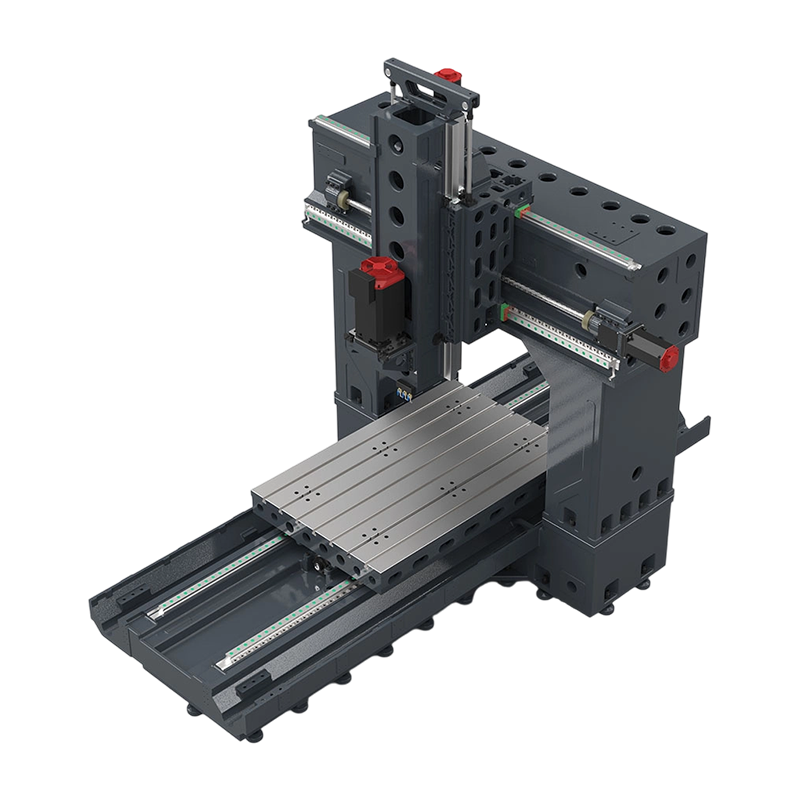 PL2016 Gantry Machining Center for Envelope ReviewConsider this model when comparing gantry machining centers by table size, rail spacing, cross-rail travel, and ram extension before spindle speed.View Product →
The precision chain: structure, thermal behavior, and geometry
On a gantry, precision is a chain rather than a single number. The base carries the table and columns. The columns support the cross rail. The cross rail carries the ram and spindle. Every joint, rail preload, and casting section adds compliance. When the ram extends, the spindle moves away from the stiffest part of the structure, so the machine must be evaluated at the position where it will actually cut.
Thermal behavior matters as much as static stiffness. A gantry can have a long warm-up cycle because the columns, cross rail, and ram respond at different rates. Ask for a thermal drift test that records spindle and axis displacement from cold start to stable temperature. A machine that moves 30 microns during warm-up may still make good parts with compensation, but the buyer should know that before signing off.
Where a gantry layout fits best
Editorial comparison for orientation, not a machine specification.
Scores compare the gantry concept with a typical vertical machining center for the same part family.
At full ram extension, the weakest point is often the ram and cross-rail interface. Check squareness between the spindle axis and the table, straightness of the cross-rail travel, and repeatability at the extended position. These checks matter more than a glossy brochure photograph of a large work envelope.
Matching the machine to the part, not the brochure
Start with a real part family, not a target machine size. Collect five inputs before comparing quotations: maximum workpiece envelope including fixture clearance, maximum part weight per table, required tolerance at the farthest cutting position, material removal rate for the roughing operation, and surface finish for the finishing operation. A gantry can be accurate on a small test piece and still struggle on a tall mold cavity if the ram is extended and the cutter pushes sideways.
- Work envelope: length, width, height, and the space needed for clamps, angle plates, and crane access.
- Part weight: table load plus fixture load, not just the workpiece.
- Accuracy position: tolerance at the corner of the envelope, not only near the center.
- Cutting duty: roughing with large cutters, finishing with small tools, or mixed duty.
- Thermal environment: shop temperature swing, direct sunlight, and nearby heat sources.
| Part family | Dominant requirement | Feature to verify |
|---|---|---|
| Large injection molds | Deep-cavity access and stable finishing accuracy | Ram extension stiffness, thermal compensation, table size |
| Aerospace frames | Long-stroke accuracy and thin-wall stability | Cross-rail straightness, squareness, dynamic response |
| Machine tool beds | Heavy workpiece support and large faces | Table load rating, foundation plan, rail spacing |
| Graphite electrodes | Fine detail, dust control, and fast finishing | Spindle speed, enclosure and extraction, smaller gantry milling options |
For a large mold base, the gantry's fixed table and overhead spindle allow the operator to inspect and re-fixture without moving the part. For an aerospace frame, the long stroke and thermal stability matter more than raw spindle power. For machine tool beds, the foundation and table load rating can decide the project before the control system is discussed.
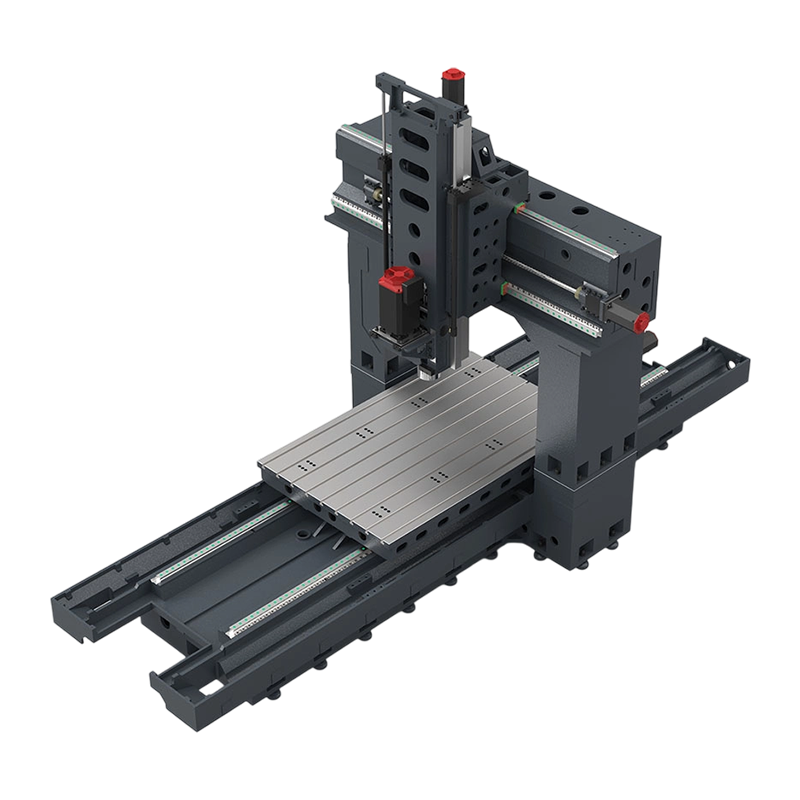 PL2518 Gantry Machining Center for Large-Part ApplicationsReview this gantry center for large mold, aerospace frame, or machine tool bed work, then request accuracy figures with test conditions.View Product →
Specification checks that protect the purchase
Ask for numbers with test conditions attached. A positioning accuracy figure without a stroke length, compensation status, and test standard is difficult to compare. The same applies to repeatability, spindle runout, and geometric accuracy. The following checks are practical for a gantry machine purchase:
- Positioning accuracy and repeatability to ISO 230-2 over the full stroke, with the test report and compensation status stated.
- Squareness and straightness to ISO 10791 test conditions for machining centers, including cross-rail and spindle-axis checks.
- Thermal drift from cold start to stable temperature, recorded at the spindle and at least one linear axis.
- Spindle taper contact, runout, and drawbar force; these affect tool life and surface finish as much as axis accuracy.
- Circular interpolation test or ballbar test to reveal servo mismatch, backlash, and geometry errors.
- Cutting test with your material and a representative fixture, not only a light aluminum demo.
Acceptance should happen after installation and leveling, not only at the factory. A machine that is accurate on a temporary floor but loses geometry after anchoring is telling you something about the foundation, the leveling procedure, or the commissioning plan. Keep the acceptance records with the machine history so future maintenance can compare against a known baseline.
Foundation, workholding, and installation risks
A gantry machining center carries a large mass and a tall structure. The foundation usually needs to be isolated from the building slab, with a leveling plan, anchor bolt layout, and drainage for coolant. Crane access should be checked before the machine arrives. A machine that cannot be loaded safely may sit idle while the factory is modified.
Workholding deserves the same attention. Large parts may need tombstone fixtures, angular supports, or custom clamping that do not interfere with the ram at full extension. Coolant and chip management also change: a fixed table can collect chips in pockets, and deep cavities may need high-pressure coolant and good filtration to keep finish stable.
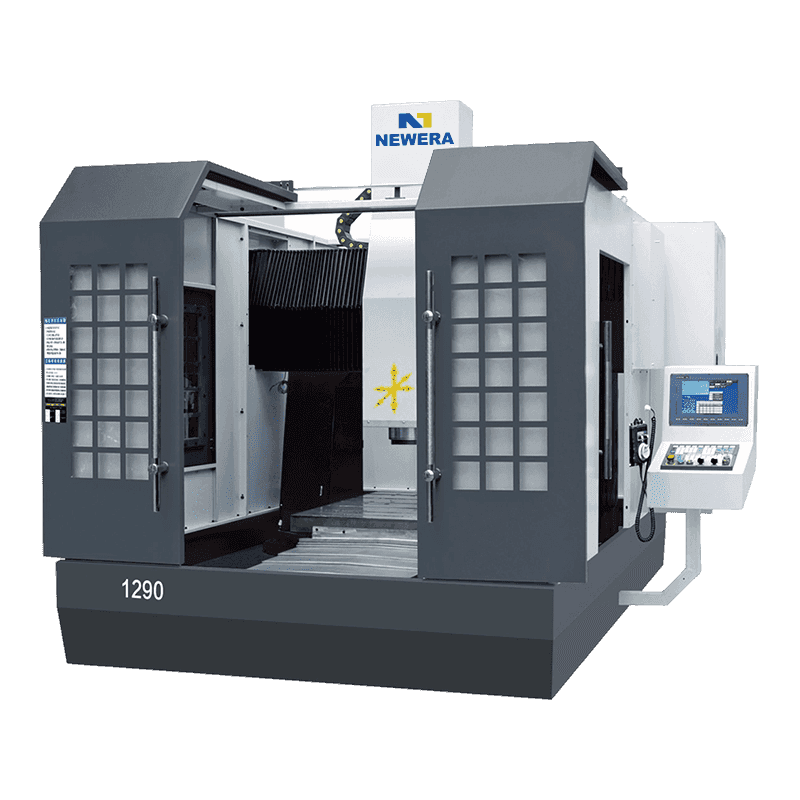
If the work is closer to precision milling, electrode making, or engraving than heavy mold roughing, a CNC gantry milling machine may be a better fit than a large double-column machining center. The lighter structure can still provide gantry access while matching the cutting duty more closely.
 NE1290 CNC Gantry Milling Machine for Precision MillingConsider this gantry milling machine for precision milling, electrode making, or engraving work where a lighter structure still offers gantry access.View Product →
A practical selection sequence
Use a sequence that keeps the decision tied to the part and the acceptance test. It also keeps the quotation comparison honest.
- Define the largest and heaviest part, including fixture and crane clearance.
- State the required tolerance at the farthest cutting position, not only at the table center.
- Shortlist the structure: double-column gantry, gantry milling machine, or vertical machining center. For background, review what a gantry machining center is and how it is built.
- Request test reports for positioning, geometry, thermal drift, and spindle condition.
- Plan the foundation, leveling, power, coolant, chip removal, and crane access before order release.
- Witness the cutting test and final acceptance after installation.
The best machine is not the one with the largest envelope or the highest spindle speed. It is the one that holds the required tolerance on your part, at the position where the tool actually cuts, with a foundation and service plan that keep it there.
Frequently asked questions
Q1. What is a CNC gantry machine used for?
It is used for large, heavy or tall workpieces that need overhead spindle access, such as mold bases, aerospace frames, machine tool beds, and large structural parts.
Q2. How much floor space does a gantry machining center need?
Plan for the machine footprint plus crane access, control cabinet clearance, coolant tank, chip bin, and a safe maintenance zone. The foundation and loading path often decide the layout.
Q3. Can a gantry machine hold precision over the full stroke?
Yes, if the structure, thermal compensation, and geometry are tested at the extended position. Ask for accuracy and repeatability data over the full stroke, not only near the table center.
Q4. What foundation is required for a double-column machining center?
Most installations need a separate, level foundation with anchor bolts and isolation from the building slab. The exact design depends on machine mass, soil conditions, and local practice.
Q5. Gantry machining center vs vertical machining center for large molds?
A gantry is usually better for large mold bases because the table is fixed and the spindle travels overhead. A vertical machining center is more efficient for small molds and high-volume small parts.
Q6. What acceptance tests should I request?
Request positioning and repeatability tests, geometric accuracy checks, thermal drift records, spindle runout and drawbar force, circular interpolation tests, and a cutting test with your material.
If you are interested in our products, please consult us.
CONTACT DETAILS
Nantong New Era Technology Co., LTD
- Five-star Industrial Park, Chongchuan District, Nantong City, Jiangsu Province, China
- TEL:+86-19851302688
- E-Mail: [email protected]
Products
Quick link
Mobile terminal
