

 русский
 عربى

Industry News
Home / News / Industry News / CNC Machine Tool Maintenance: Daily to Annual Schedules and Fault Hotspots
CNC Machine Tool Maintenance: Daily to Annual Schedules and Fault Hotspots
 2026.11.13
 Industry News
A mould shop skipped coolant changes for three months because the machine ran fine and the tank looked clear. In the fourth month, a vertical machining center seized a spindle bearing a week before a shipment. The repair bill, the air freight and the overtime together came to roughly ten times the cost of three years of grease for that bearing.
That is the normal shape of CNC machine tool maintenance. Wear accumulates quietly, then arrives all at once. Handled properly, maintenance is not repair work at all — it is a fixed routine that watches three predictable forms of decay: lubrication breakdown, contamination and thermal drift. Hold those three in check and most machines run for a decade without drama. Let them slide and the machine becomes a repair sink within three years.
What follows is the order of operations: what to do daily, what to do monthly, where faults actually cluster, and which questions about maintenance are worth asking before you sign for a new machine.
Content
- 1 Maintenance Is a Scheduling Problem First, a Technical One Second
- 2 Daily, Weekly, Monthly, Annual: A Table That Actually Gets Followed
- 3 Where the Maintenance Hours Actually Go
- 4 Lubrication, Coolant and Way Covers: Where Faults Cluster
- 5 Accuracy Drift: Check in This Order
- 6 Die-Sinking EDM Needs Its Own Routine
- 7 Spare Parts and Support: Questions Worth Asking Before You Buy
- 8 Frequently Asked Questions About CNC Machine Tool Maintenance
- 8.1 Q1. How often should CNC machine tool maintenance be performed?
- 8.2 Q2. What causes most CNC machine breakdowns?
- 8.3 Q3. Is daily maintenance necessary on a lightly used machine?
- 8.4 Q4. How is EDM maintenance different from machining center maintenance?
- 8.5 Q5. Can a CNC machine be repaired without maintenance records?
- 8.6 Q6. Does spindle noise always mean the bearing must be replaced?
- 8.7 Q7. Are low-cost third-party parts a false economy for CNC repair?
- 8.8 Q8. How do we know when a way or screw needs replacing rather than adjusting?
Maintenance Is a Scheduling Problem First, a Technical One Second
Most shops that struggle with CNC maintenance are not short of technical knowledge. They are short of a timetable. Topping up way oil, changing a filter, testing coolant concentration — each takes minutes. Left to whoever happens to remember, none of them happens.
There is an arithmetic point that rarely gets written down either. A stopped machine does not produce, so the real cost of a missed lubrication interval is not the price of the grease. It is the price of the lost spindle hours, and that number is far larger. Spending the maintenance time before a failure is almost always cheaper than spending it afterwards.
A twenty-year-old machine with a paper logbook usually outlasts a five-year-old machine with no schedule at all. Records are not bureaucracy; they are the only way a technician can tell whether a wear pattern is new or has been creeping for two years.
Daily, Weekly, Monthly, Annual: A Table That Actually Gets Followed
Routines survive when they are short, specific, and attached to a shift handover. The table below is a workable baseline for one machine on one shift. Three-shift production should split the weekly items into several shorter checks rather than dropping them entirely.
| Interval | Key tasks | Typical time | What happens if it is skipped |
|---|---|---|---|
| Daily | Wipe exposed surfaces and clear chips; drain coolant nozzles; check oil levels; check air pressure; listen for noise during rapid moves | 15–20 min | Chips pack into way covers, lubrication starves, early bearing noise is masked by general shop sound |
| Weekly | Clean coolant filters; inspect way covers and wipers; check clamping pressure; clean cabinet fan and air-conditioner filters; wipe the spindle taper | 30–45 min | Coolant turns rancid quickly, a torn cover lets chips straight onto the ways, cabinet temperature climbs |
| Monthly | Replenish or replace grease; measure coolant concentration and pH with a refractometer; check backlash; clean dust inside the electrical cabinet | 2–3 h | Below pH 8.5 corrosion starts, and backlash grows without any visible symptom |
| Annual | Replace spindle grease by running hours; change all filter elements; re-level and re-check geometry; inspect cables and grounding | 8–16 h | Error accumulates silently and then appears as a batch of scrap parts |
Notice that no single item is difficult. The failure mode is never "we could not do it" — it is "nobody owned it".
Where the Maintenance Hours Actually Go
The chart below shows how a normal week of upkeep typically distributes across task types. Cleaning and lubrication together account for more than half of it, and neither of those needs an engineer — only a fixed fifteen-minute slot that is not squeezed out by production pressure.
Lubrication, Coolant and Way Covers: Where Faults Cluster
Three subsystems account for a large share of avoidable breakdowns on both machining centers and die-sinking machines. The diagram marks the points worth touching every time an operator walks past the machine.
- Lubrication. Use the grease grade stated on the machine plate. Over-greasing is as harmful as under-greasing, because surplus grease glues chips onto the ways.
- Coolant. Measure concentration with a refractometer against the supplier's recommendation, commonly in the 5–10% range, and log the pH. Once pH drops below 8.5, corrosion and odour follow.
- Way covers and wipers. A torn cover lets chips in faster than anyone can clean them out. Replace rather than patch.
- Spindle taper. Wipe it before every tool change. One chip on the taper is enough to produce runout that gets blamed on the tool.
- Electrical cabinet. Keep the air conditioner or fan working. A large share of control and drive failures trace back to heat, not to component age.
Accuracy Drift: Check in This Order
When parts start running out of tolerance, the first instinct is to blame the program. It is almost never the program. Work through the list below and the cause usually shows up within the first three steps.
- Thermal state. Let the machine run through a warm-up cycle and measure again. A cold machine and a warm machine are two different machines.
- Tooling. Check holder condition, pull stud torque and tool runout before touching the control.
- Backlash and lost motion. Measure with a dial indicator on each axis. Growing backlash points at screw or bearing wear, not at the servo.
- Geometry. Level, squareness and parallelism come last, because they change slowly and are expensive to disturb.
- Records. Compare today's readings with the last entry in the log. A single number means little; a trend means everything.
Die-Sinking EDM Needs Its Own Routine
A machining center runs on rotation and grease. A sinker EDM runs on fluid and current, so its maintenance priorities are different. The items that matter most are dielectric condition, filter cartridges, the electrode chuck and the discharge circuit.
- Change filter cartridges on a set cycle, not when the fluid looks dirty. Cloudy dielectric produces unstable discharge, worse surface finish and faster electrode wear.
- Keep the dielectric level and temperature within specification; level drops change flushing behaviour at the gap.
- Clean the electrode chuck and check clamping repeatability — a worn chuck shows up as depth error that looks like a control problem.
- Inspect cables and the discharge path for damage; arcing faults are often mechanical, not electronic.
- Drain and clean the tank at the annual service rather than simply topping it up.
Shops that already follow a detailed maintenance routine for EDM equipment tend to report far fewer mid-job interruptions, because the failure modes are caught while the tank is still clean.
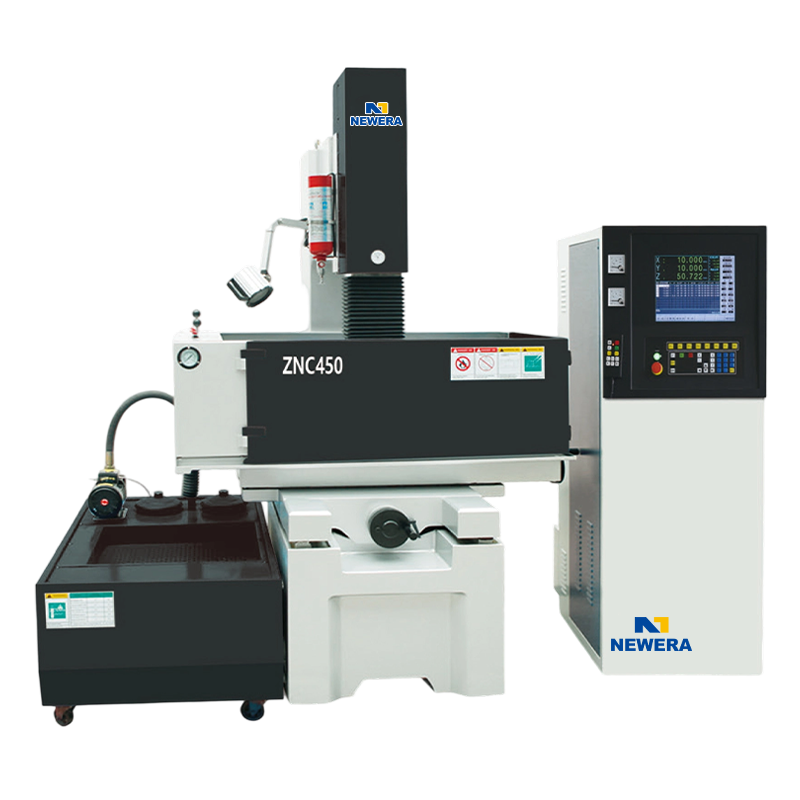 ZNC 450 EDM Die Sinking MachineA sinker EDM model with selectable control cabinets, suited to shops that prioritize planned maintenance and fewer mid-job interruptions.View Product →
Spare Parts and Support: Questions Worth Asking Before You Buy
Maintenance cost is decided at the quotation stage, not at the first breakdown. Ask these five questions of any supplier, and expect specific answers rather than reassurance.
- What is the spindle grease replacement interval, and how many hours of labour does it take?
- Are the linear guides and ball screws standard catalogue parts, and what is the delivery lead time for a replacement screw?
- Is there a service engineer in the region, or is support remote-only?
- Does the machine ship with a spare parts list and assembly drawings?
- Does the warranty cover operator error, or only component failure?
A supplier who cannot answer these questions is effectively handing the maintenance risk to the buyer. On the entry-level side of the market, machines such as the economical VMC series are usually specified with a documented parts list precisely because they run in smaller shops without a dedicated maintenance team.
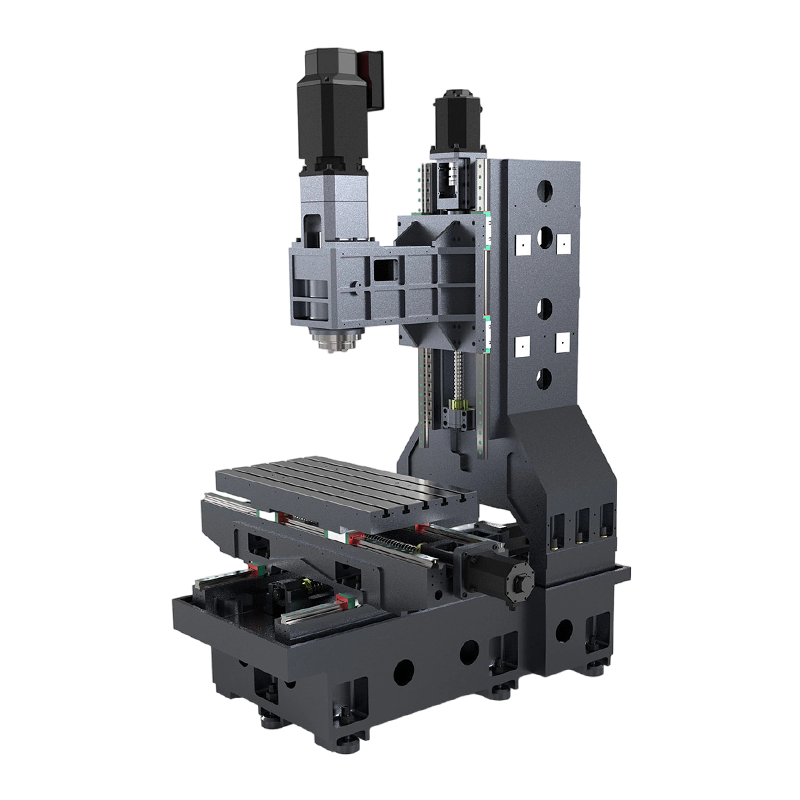 Economical VMC EV850 Vertical Machining CenterAn entry-level vertical machining center aimed at smaller shops, offered with a documented parts list to support maintenance planning.View Product →
The same logic applies to grinding. Surface grinders live or die on wheel balance, coolant cleanliness and table lubrication, and the consumable side of that list is far cheaper than the spindle side.
 250AH/250AHR/250AHD Precision Surface Grinding MachineA precision surface grinder series from an experienced OEM/ODM manufacturer, relevant for shops planning routine wheel, coolant and lubrication checks.View Product →
Frequently Asked Questions About CNC Machine Tool Maintenance
Q1. How often should CNC machine tool maintenance be performed?
Daily cleaning and level checks, weekly coolant and filter checks, monthly lubrication and backlash checks, and an annual geometry and calibration service. Three-shift operation compresses the calendar, not the task list.
Q2. What causes most CNC machine breakdowns?
Lubrication starvation, contaminated coolant, spindle and bearing wear, and electrical faults driven by heat inside the cabinet. Nearly all of them give warning signs weeks before the failure.
Q3. Is daily maintenance necessary on a lightly used machine?
Yes, though it shrinks to wiping surfaces, checking oil and listening for noise. Idle time brings its own risks — coolant separates and grease can settle away from the contact surfaces.
Q4. How is EDM maintenance different from machining center maintenance?
EDM depends on dielectric condition, filter cartridges and the discharge circuit rather than high-speed bearings. Fluid clarity, conductivity and tank cleanliness matter more than oil pressure and way lubrication.
Q5. Can a CNC machine be repaired without maintenance records?
It can, but diagnosis takes longer. Records tell a technician what has already been replaced and when, which usually cuts fault-finding time and the final invoice along with it.
Q6. Does spindle noise always mean the bearing must be replaced?
No. Check the taper for chips, verify drawbar force and test with a known-good holder first. A surprising share of "spindle noise" disappears after a taper clean and a drawbar adjustment.
Q7. Are low-cost third-party parts a false economy for CNC repair?
For filters, wipers and seals, usually not a problem. For spindles, ball screws and servo drives, the tolerance and lead-time differences tend to cost more than the price gap.
Q8. How do we know when a way or screw needs replacing rather than adjusting?
When backlash still exceeds the specification after adjustment, or when surface finish deteriorates on one axis only. A trend in the log is more reliable than a single measurement.
If you are interested in our products, please consult us.
CONTACT DETAILS
Nantong New Era Technology Co., LTD
- Five-star Industrial Park, Chongchuan District, Nantong City, Jiangsu Province, China
- TEL:+86-19851302688
- E-Mail: [email protected]
Products
Quick link
Mobile terminal
