

 русский
 عربى

Industry News
Home / News / Industry News / CNC EDM vs Conventional EDM: Control, Accuracy, Setup, and Cost Differences
CNC EDM vs Conventional EDM: Control, Accuracy, Setup, and Cost Differences
 2026.11.04
 Industry News
Two die-sinking machines can sit side by side with the same table size, the same generator cabinet and a similar footprint, and still be entirely different tools in daily use. The decisive difference is not the power supply — it is who owns the orbit. On a conventional (manual or ZNC) sinker, the operator controls orbiting, depth compensation and wear offset by hand, by feel and by memory. On a CNC sinker, those movements are programmed, stored and repeated on the next job. Price, setup time, electrode count, scrap rate and how quickly a new hire becomes productive all follow from that single split.
The comparison below is written for shops that are buying a ram EDM, replacing an ageing manual machine, or wondering whether the CNC premium is worth it. It also clears up a naming trap that makes "CNC EDM vs conventional EDM" one of the more confusing searches in this field.
Content
- 1 The short answer: when each machine wins
- 2 How the control loop actually differs
- 3 Accuracy, surface finish and repeatability
- 4 What it costs to run
- 5 Where conventional EDM still earns its place
- 6 A buying checklist for either machine type
- 7 One naming trap: two different "conventional" comparisons
- 8 Frequently asked questions
- 8.1 Q1. What is the difference between CNC EDM and conventional EDM?
- 8.2 Q2. Is CNC EDM more accurate than manual EDM?
- 8.3 Q3. How much does a CNC EDM machine cost?
- 8.4 Q4. Can a conventional EDM be upgraded to CNC?
- 8.5 Q5. What is the difference between sinker EDM and wire EDM?
- 8.6 Q6. Which materials can be machined by EDM?
The short answer: when each machine wins
Buy CNC if you burn repeat work — multi-cavity dies, deep ribs, tight tolerance stacking, or a part family that returns every month. Buy conventional if the work is one-off, geometrically simple and your operator has years on the handwheel. If you fall between those two, a PNC machine (programmable Z axis with a simpler control) usually closes the gap at a lower price than full CNC.
| Feature | Conventional / ZNC | PNC | CNC |
|---|---|---|---|
| Axis control | Z servo only, hand-set parameters | Programmable Z, limited X/Y | X, Y, Z, often C and a fourth axis |
| Orbit | Manual feed or mechanical attachment | Simple programmed step-over | Programmed 2D/3D orbits with adaptive step |
| Depth and wear offset | Operator sets stop and compensates by eye | Semi-automatic | Automatic, stored in program |
| Electrode handling | Manual alignment each change | Manual, faster re-zero | Automatic changer on many models |
| Best fit | Single cavities, repair, toolroom | Small batches, simple dies | Repeat production, complex cavities |
How the control loop actually differs
Inside a conventional sinker
A ZNC machine drives one servo axis. The operator dials in discharge current, pulse on/off time, gap voltage and servo speed in fixed steps, then works the electrode down against a stop. Orbiting is physical: nudging X and Y by small increments, or using a mechanical orbit head, while listening to the gap for the crackle that means a stable burn. When the electrode wears at the corners, compensation is a judgment call or a second, smaller electrode.
Inside a CNC sinker
The control drives multiple axes and calculates the orbit itself — circular, square, vector or 3D — with a programmed step-over and a programmed final depth. Generator settings follow the orbit automatically, and adaptive circuits watch the gap and adjust the burn as the working area changes. An electrode changer swaps roughing and finishing tools without an operator, and wear data is written back into the program so the next cavity starts from the same numbers.
The practical consequence is simple: on a CNC the know-how lives in the program, on a manual machine it lives in the person standing at the console.
 CNC 1060 EDM Die-Sinking MachineCNC die-sinking EDM model CNC 1060, built for shops that want process know-how held in the program, with an optional CNC electrical box.View Product →
Accuracy, surface finish and repeatability
Conventional machines are not inaccurate. A well-maintained ZNC sinker in skilled hands can hold fine tolerance on a single cavity. The genuine difference is repeatability — across forty cavities, three shifts and two operators. CNC sinkers are commonly specified with positioning repeatability in the low single-digit micron range, roughly ±0.002 to ±0.005 mm depending on model and grade, and the orbit runs identically every cycle, which is what keeps cavity-to-cavity variation small.
Surface finish is usually specified through the VDI 3400 guideline or directly in Ra. Fine EDM passes typically land around Ra 0.1–0.4 µm, with dedicated mirror circuits going finer. What the CNC adds is not a magic finish but a repeatable one — the same Ra on cavity nine as on cavity one.
This setup count is where the difference compounds. Every electrode change on a manual machine means re-aligning, re-zeroing and re-establishing the burn — minutes that are hard to recover when a die has ten cavities.
What it costs to run
A CNC sinker carries a real premium up front over a comparable ZNC model, and the gap widens with axis count, electrode changer and control features. The payback arrives from three directions: fewer electrodes (one CNC electrode with an orbit often replaces several stepped manual electrodes), less operator time per cavity, and less scrap during finishing passes.
Below that crossover the manual machine usually wins on total cost — lower capital, and the job is finished before programming effort has been amortised. Above it, the CNC curve keeps falling because labour and electrode consumption scale with every cavity.
Where conventional EDM still earns its place
- Single cavities and repair work. A cracked die insert or a weld repair rarely justifies CAM time; a manual burn gets it back into the press the same day.
- Toolroom flexibility. No model, no program, no post-processor — just clamp, align and burn.
- Capital discipline. Small shops with steady but simple work put less money on the floor and keep the balance sheet clean.
- Straight-walled geometry. Through holes, simple blind pockets and marking operations gain little from an orbit.
Machines in the ZNC-450 class are built precisely for that territory: compact, mechanically simple, and priced so a toolroom can own one without a business case.
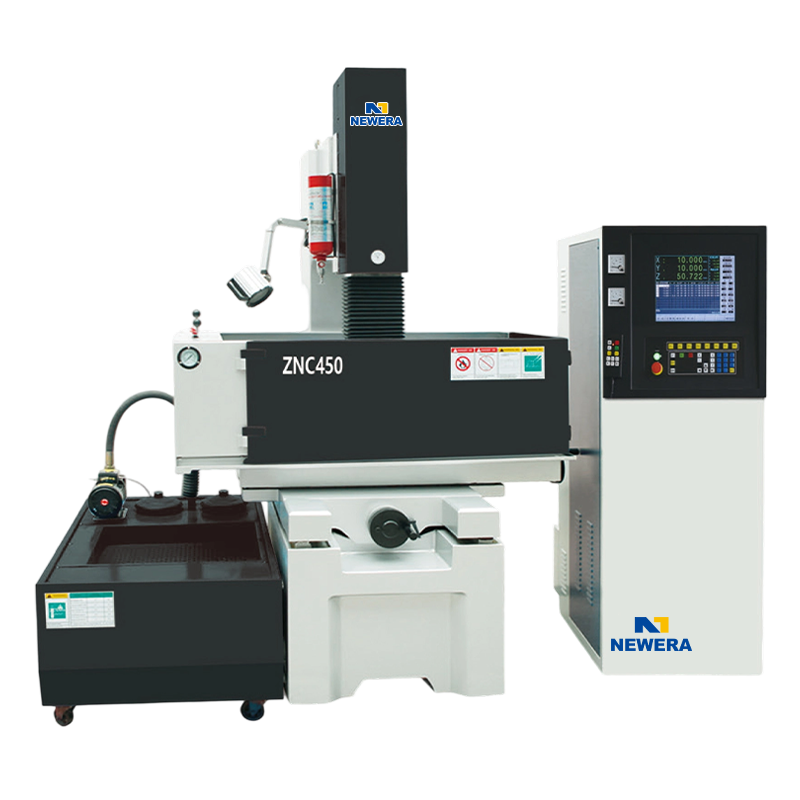 ZNC 450 EDM Die-Sinking MachineCompact ZNC-type die-sinking EDM for toolrooms, with several optional control cabinet configurations available for different operating preferences.View Product →
The middle ground worth pricing
PNC sits where most first-time buyers actually land. You get a programmable Z axis, stored depths and a repeatable finish pass, but you keep the manual electrode handling and the lower price. For a shop burning three to five simple cavities a month, it frequently returns the investment faster than a full CNC.
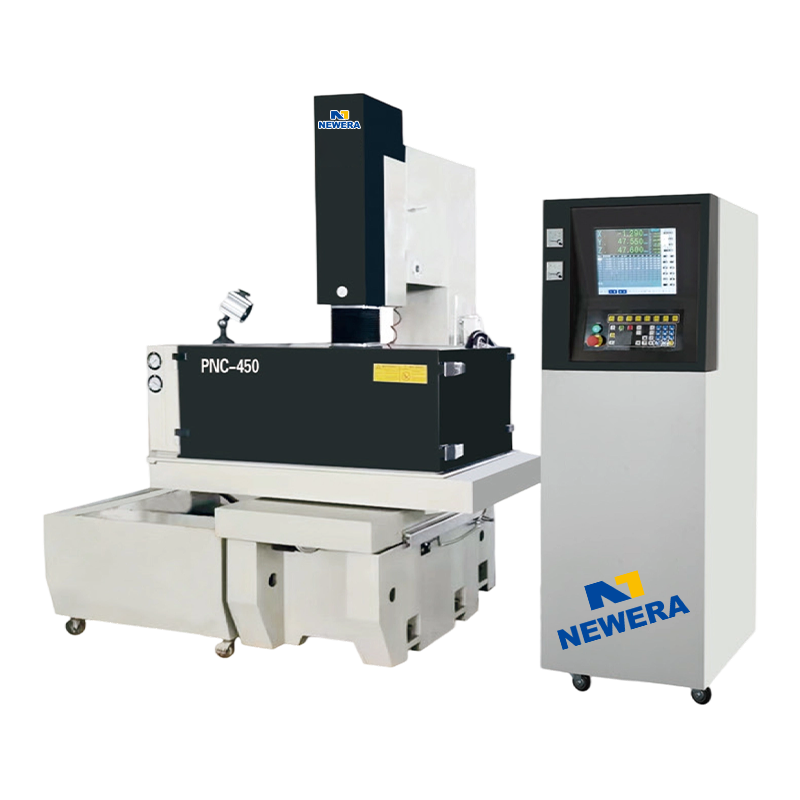 PNC 450 EDM Die-Sinking MachinePNC 450 die-sinking EDM offers programmable Z-axis control and manual electrode handling, positioned between manual machines and full CNC for simple cavity work.View Product →
A buying checklist for either machine type
- Count cavities, not machines. Ten inserts a year with two cavities each points to manual; the same ten with twenty cavities each points to CNC.
- Write down the tolerance you must hold across all cavities, not just the best one your operator ever produced.
- Budget electrodes as a running cost. A CNC orbit can cut electrode consumption sharply — that is often the fastest part of the payback.
- Check the skill supply. Manual EDM depends on an experienced hand; CNC depends on someone who can program and verify orbits.
- Inspect the tank, flushing and filtration before the control features. Poor flushing limits accuracy on every machine, whatever the screen says.
- Confirm service and spare parts locally, especially for the generator and servo drive.
If you are still weighing control levels, this breakdown of whether a CNC die-sinking machine is the best choice for a given workload is a useful second opinion.
One naming trap: two different "conventional" comparisons
Half the confusion around this keyword comes from language. Sometimes "conventional EDM" means a manual ram EDM, as described above. Other times it means conventional machining — milling, turning, drilling — set against EDM as a process.
In that second sense the contrast is different again. EDM removes material with sparks rather than a cutting edge, so hardness barely matters: hardened tool steel at 60 HRC cuts as readily as annealed stock. There is no cutting force, so thin walls and delicate features survive. The trade-offs are that the workpiece must conduct electricity, that graphite and ceramics need special handling, that removal rates are slower than rough milling, and that dielectric oil, filtration and fire precautions are permanent operating costs.
Frequently asked questions
Q1. What is the difference between CNC EDM and conventional EDM?
Conventional EDM is controlled by the operator, who sets discharge parameters and orbits the electrode by hand. CNC EDM programs the orbit, depth and wear compensation, so the same burn repeats without intervention.
Q2. Is CNC EDM more accurate than manual EDM?
On a single cavity the difference can be small. Across many cavities, CNC EDM wins on repeatability because the orbit and offsets stay identical between cycles, shifts and operators.
Q3. How much does a CNC EDM machine cost?
Price depends on table size, axis count, electrode changer and generator class. A bare two-axis machine and a fully automated one sit in very different brackets, so ask for a configuration-specific quotation rather than a headline figure.
Q4. Can a conventional EDM be upgraded to CNC?
Rarely worth it. Full CNC needs different servo drives, position feedback, a new generator interface and often a rebuilt ram — the cost approaches a new machine while the mechanical structure stays old.
Q5. What is the difference between sinker EDM and wire EDM?
Sinker EDM burns a three-dimensional cavity with a shaped electrode submerged in oil. Wire EDM cuts a two-dimensional profile with a travelling wire in water, and is used for punches, dies and plates rather than cavities.
Q6. Which materials can be machined by EDM?
Any electrically conductive material: tool steel, hardened die steel, stainless, titanium, carbide, copper alloys and superalloys. Plastics, ceramics and most composites cannot be cut by EDM directly.
The honest summary is that neither machine is obsolete. A CNC sinker buys repeatability and releases skilled people from dial-watching; a conventional sinker buys simplicity and a fast route from clamp to burn. Match the control level to the number of cavities you actually produce, and the argument resolves itself.
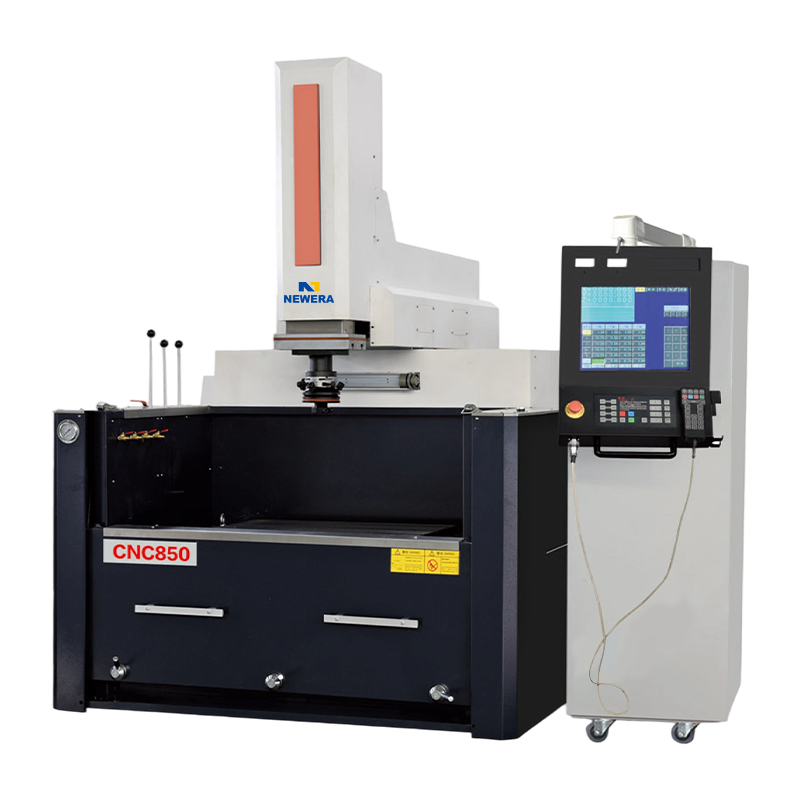
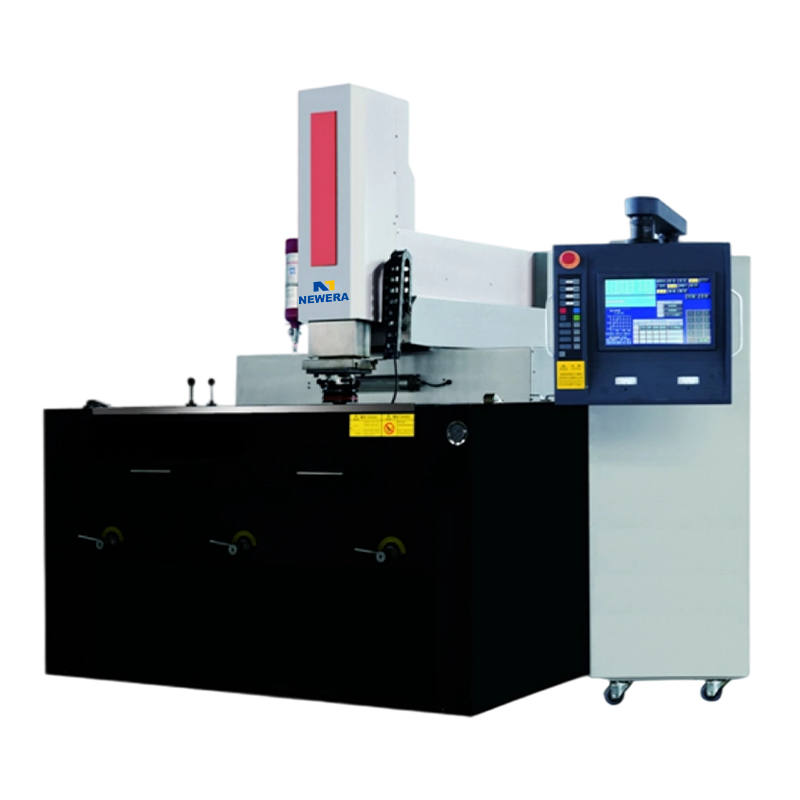
If you are interested in our products, please consult us.
CONTACT DETAILS
Nantong New Era Technology Co., LTD
- Five-star Industrial Park, Chongchuan District, Nantong City, Jiangsu Province, China
- TEL:+86-19851302688
- E-Mail: [email protected]
Products
Quick link
Mobile terminal
