

 русский
 عربى

Industry News
Home / News / Industry News / EDM technology: Applications, Selection Criteria, and Practical Guidance
EDM technology: Applications, Selection Criteria, and Practical Guidance
 2026.10.20
 Industry News
Picture a hardened H13 mold insert with a 0.8 mm deep rib and a square internal corner that no end mill can reach. The cavity has already been milled, but the last details need a process that cuts without cutter pressure. That is where EDM technology earns its place. Electrical discharge machining removes conductive metal with repeated controlled sparks in a dielectric fluid; it does not rely on mechanical force, so hardened steel, carbide, and thin ribs can be finished after heat treatment. The practical conclusion: EDM is a complement to milling, not a replacement. Use milling for bulk removal, then EDM for sharp corners, deep slots, fine detail, and hard materials.
Content
- 1 What EDM Technology Actually Does
- 2 Core Components and the Spark Gap
- 3 Control Systems: ZNC, PNC, and CNC
- 4 Materials, Accuracy, and Surface Finish
- 5 Where EDM Technology Fits in Production
- 6 Practical Buying and Maintenance Checks
- 7 Frequently Asked Questions
- 7.1 Q1. What is EDM technology used for in mold making?
- 7.2 Q2. How does sinker EDM differ from wire EDM?
- 7.3 Q3. Can EDM machine hardened steel and carbide?
- 7.4 Q4. What affects EDM surface finish and accuracy?
- 7.5 Q5. How much does a CNC EDM machine cost?
- 7.6 Q6. What maintenance does an EDM machine need?
What EDM Technology Actually Does
EDM is a thermal erosion process. A shaped electrode or a wire is fed toward the workpiece, the gap is flooded with dielectric fluid, and a pulsed voltage creates sparks that melt and vaporize tiny amounts of material. Because the electrode never touches the work, tool force is essentially zero. That is why EDM can machine hardened steel after heat treatment and hold detail in deep cavities. The trade-off is speed: metal removal is slower than milling, and the process consumes electrode material, dielectric, and filter media. Industry overviews describe the same basic mechanism and separate EDM into sinker, wire, and hole-drilling variants.
| Variant | Tool | Typical geometry | Best fit | Main watch-out |
|---|---|---|---|---|
| Sinker / die-sinking | Shaped electrode, often copper or graphite | Cavities, ribs, sharp corners, deep slots | Mold inserts, dies, hard steel after heat treatment | Electrode wear and debris flushing |
| Wire EDM | Travelling wire | Through-profiles, punches, dies, small radii | Plate parts with tight tolerances | Needs conductive material and a start hole |
| Fast-hole drilling | Tubular electrode | Small deep holes | Cooling channels, injector holes, start holes | Hole taper and electrode guidance |
Core Components and the Spark Gap
Every EDM technology decision comes back to five elements: the generator, the servo, the dielectric system, the electrode, and the controller. The generator sets current and pulse timing. The servo holds the spark gap, often measured in hundredths of a millimeter. The dielectric flushes debris and cools the gap. The electrode shape transfers into the cavity. The controller coordinates depth, orbit, and retract.
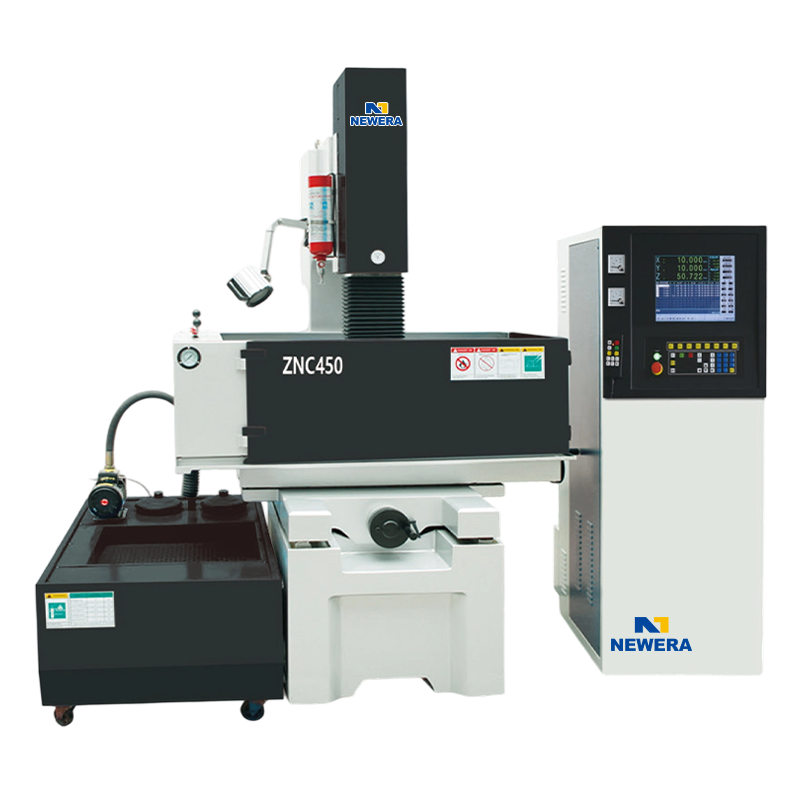
If one element is weak, the symptom appears as unstable arcing, taper, poor surface finish, or slow cycle time. A common mistake is to blame the generator when the real problem is poor flushing in a deep rib. For a CNC die-sinking platform with automatic programming and multi-axis control, the CNC-650 is one example within the EDM die-sinking machine range.
 CNC-650 Die-Sinking EDM for Programmable Multi-Axis WorkA CNC die-sinking EDM platform with automatic programming and multi-axis control; optional AC/Japan Panasonic servo motor supports repeatable, program-linked cycles.View Product →
Control Systems: ZNC, PNC, and CNC
Control level changes how much of the cycle is manual. ZNC machines typically rely on manual settings for current, pulse, and depth; they suit simple cavities and shops that value straightforward operation. PNC adds program control for repeatable cycles but often keeps setup decisions with the operator. CNC EDM links the generator, servo, and multi-axis movement to a program; it supports automatic electrode changing, orbit control, and unattended running on repeat work. The right choice is not "the most CNC"—it is the control level that matches batch size, skill level, and how often the same cavity repeats. The radar chart below is a qualitative comparison, not a model specification. For simple, cost-controlled die-sinking work, the ZNC-450 is a practical entry point.
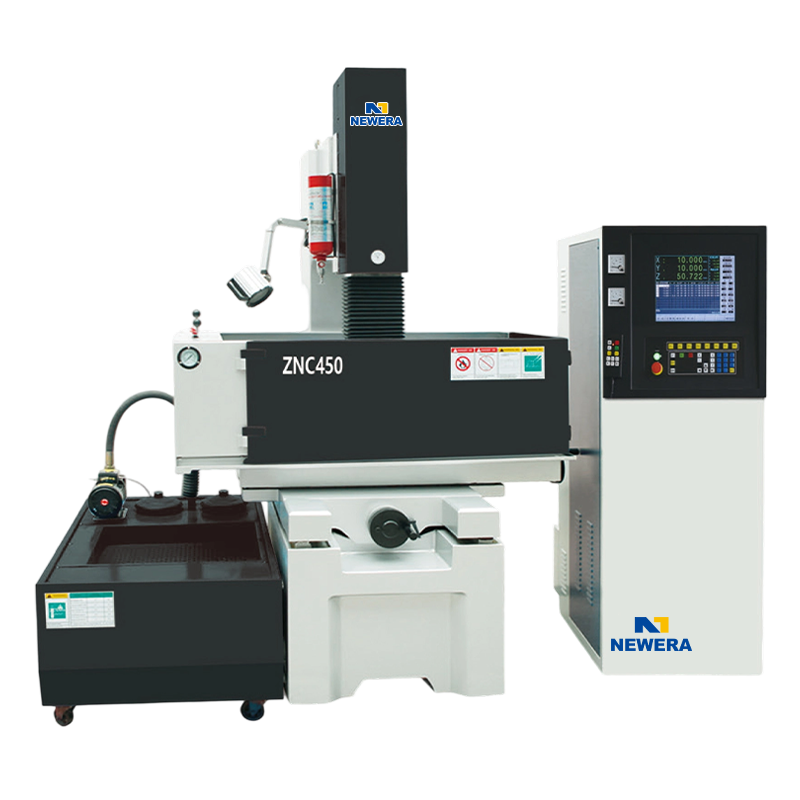 ZNC-450 Manual Die-Sinking EDM Entry ModelA ZNC-type sinker EDM for simple, cost-controlled cavities, with selectable control cabinets for shops preferring straightforward manual settings.View Product →
Materials, Accuracy, and Surface Finish
EDM works on conductive materials. Common shop materials include tool steel, pre-hardened mold steel, stainless steel, carbide, copper alloys, and some titanium alloys. Aluminium can be cut, but high conductivity and low melting point change the window; graphite electrodes are common for steel, while copper is often chosen for fine detail and low wear. Accuracy depends on machine geometry, electrode wear compensation, flushing, and thermal stability. Surface finish depends on pulse energy: roughing removes material faster and leaves a coarser surface; fine finishing lowers current and produces a finer surface but takes longer. Published EDM application notes commonly describe this trade-off. A practical rule is to plan roughing, semi-finishing, and finishing as separate steps rather than asking one setting to do everything.
Where EDM Technology Fits in Production
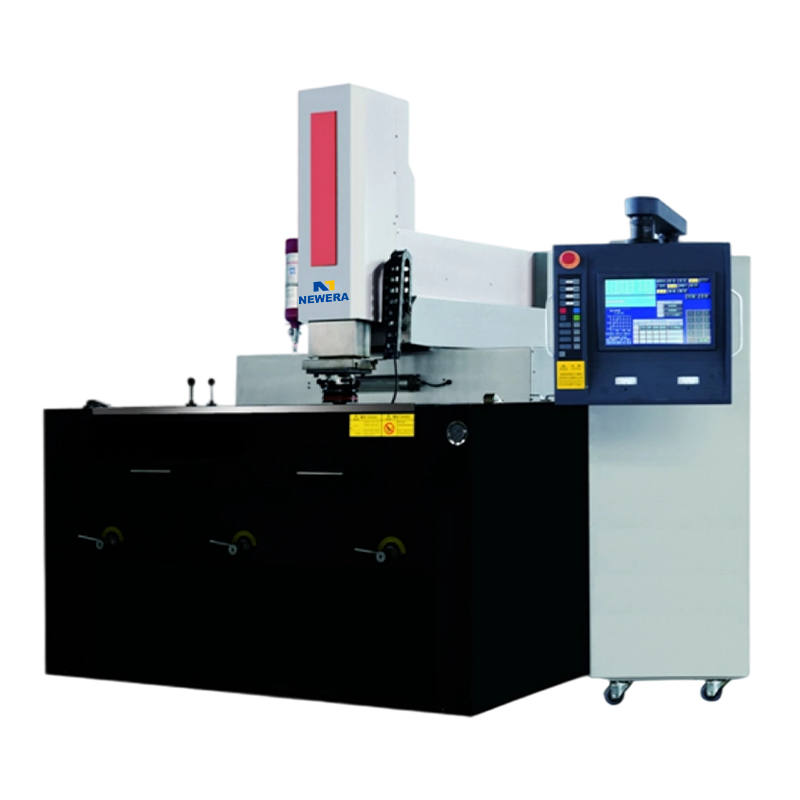
EDM is strongest in the last third of the process chain. Mold shops use sinker EDM for cavity details, slide faces, and ribs; wire EDM for punches, dies, and close-tolerance profiles; and fast-hole drilling for water lines and start holes. Aerospace and medical suppliers use it for heat-resistant alloys and burr-free internal features. Electronics tooling uses it for fine connectors, small dies, and graphite electrodes. The process also fits repair work: a worn cavity can be reworked without annealing the whole insert. The limitation is equally practical—EDM needs a conductive workpiece, a stable dielectric, and a path for debris to leave the gap. If the design traps debris, no controller setting will fully rescue the cycle. For larger mold bases and deep cavities, the CNC-1060 extends the working envelope.
 CNC-1060 Die-Sinking EDM for Larger Mold BasesA CNC sinker EDM positioned for larger mold bases and deep cavities, with an optional AC/Japan Panasonic servo motor for the control cabinet.View Product →
Practical Buying and Maintenance Checks
Before buying, test the actual cavity, not just a demonstration sample. Bring a part with the deepest rib, smallest corner, and tightest tolerance you expect. Check tank size against your largest insert, electrode capacity, generator resolution, flushing options, and whether the controller can store your common programs. Ask for electrode wear data from the test, not a catalogue claim. On the service side, confirm spare parts, training, and response time. Maintenance is mostly discipline: clean the dielectric, check filters, inspect hoses, keep the tank clean, and verify the servo and gap voltage. A neglected dielectric system shows up as unstable arcing and poor surface finish long before a major breakdown. The EDM machine selection guide covers more factory-level checks.
- Test cavity with the deepest rib and smallest corner
- Tank size against the largest insert
- Electrode capacity and wear data from the test
- Flushing pressure and debris path
- Controller program storage and operator training
- Spare parts and service response time
Frequently Asked Questions
Q1. What is EDM technology used for in mold making?
EDM technology is used for cavity details, sharp internal corners, deep ribs, slide faces, and hardened inserts that cannot be cut efficiently by milling. Sinker EDM shapes the cavity; wire EDM cuts punches, dies, and precise profiles.
Q2. How does sinker EDM differ from wire EDM?
Sinker EDM uses a shaped electrode to burn a cavity or detail into the workpiece. Wire EDM uses a travelling wire to cut through a plate along a programmed path, so it is common for punches, dies, and start-hole profiles.
Q3. Can EDM machine hardened steel and carbide?
Yes. EDM can machine conductive hardened steel, carbide, and many wear-resistant alloys after heat treatment because it removes material with sparks rather than cutter force. The material must be conductive, and the flushing path must be planned.
Q4. What affects EDM surface finish and accuracy?
Pulse energy, electrode wear, spark gap control, flushing, machine geometry, and thermal stability all matter. Roughing settings remove metal faster but leave a coarser finish; fine finishing lowers current and takes longer.
Q5. How much does a CNC EDM machine cost?
Price depends on tank size, generator capability, number of axes, automatic electrode changing, controller level, and service support. A small ZNC machine is usually a lower entry point; a CNC die-sinking machine with automation costs more, so compare cost per qualified cavity rather than headline price.
Q6. What maintenance does an EDM machine need?
Keep the dielectric clean, replace filters on schedule, inspect hoses and seals, clean the work tank, and check gap voltage and servo response. Poor dielectric condition often appears first as unstable arcing, taper, or a rough surface finish.
If you are interested in our products, please consult us.
CONTACT DETAILS
Nantong New Era Technology Co., LTD
- Five-star Industrial Park, Chongchuan District, Nantong City, Jiangsu Province, China
- TEL:+86-19851302688
- E-Mail: [email protected]
Products
Quick link
Mobile terminal
