

 русский
 عربى
عربى
Industry News
Beginner’s Guide: How to Operate a PNC EDM Die Sinking Machine?
 2026.05.20
 Industry News
Quick Answer
Operating a PNC EDM Die Sinking Machine involves five core steps: workpiece clamping and alignment, electrode preparation and installation, dielectric fluid setup, parameter programming (discharge current, pulse duration, gap voltage), and cycle monitoring. When configured correctly, a CNC die sinking EDM can achieve surface finishes as fine as Ra 0.2 µm and positional accuracy within ±0.002 mm — making it one of the most reliable industrial EDM solutions for mold making, aerospace tooling, and precision component manufacturing.
Content
- 1 What Is a PNC EDM Die Sinking Machine and Why Does It Matter?
- 2 Key Components of a CNC Die Sinking EDM You Must Understand First
- 3 Step-by-Step: How to Operate a PNC EDM Die Sinking Machine
- 4 EDM Parameter Impact on Surface Finish and Removal Rate
- 5 Choosing the Right Electrode Material for Your Mold Making EDM Application
- 6 PNC EDM vs Conventional EDM — Capability Radar Comparison
- 7 Common Mistakes Beginners Make on CNC Die Sinking EDM — and How to Avoid Them
- 8 Achievable Surface Roughness (Ra) at Each Machining Stage
- 9 Safety Practices and Routine Maintenance for Industrial EDM Solutions
- 10 Real-World Applications Where PNC EDM Die Sinking Machines Excel
- 11 About Nantong New Era Technology Co., Ltd
- 12 Frequently Asked Questions About PNC EDM Die Sinking Machines
What Is a PNC EDM Die Sinking Machine and Why Does It Matter?
A PNC EDM Die Sinking Machine (also called a ram EDM or sinker EDM) uses controlled electrical discharges — sparks — to erode electrically conductive materials with extreme precision. Unlike conventional cutting tools, the electrode never makes physical contact with the workpiece. This non-contact process eliminates mechanical stress, making it ideal for hardened steels, titanium, tungsten carbide, and other difficult-to-machine materials.
The "PNC" designation refers to programmable numerical control — a control architecture that allows operators to store and recall complex machining programs, automate multi-stage cavity cycles, and maintain consistent results across production runs. Combined with the inherent advantages of precision EDM machining, a PNC platform dramatically reduces operator dependency and setup variability.
Industries that rely on mold making EDM machines include automotive (injection mold cavities), medical devices (micro-surgical tool molds), consumer electronics (connector and housing dies), and aerospace (turbine blade fixtures). The ability to produce sharp internal corners, deep ribs, and complex 3D cavities with no taper makes die sinking EDM irreplaceable in these sectors.
Non-Contact Erosion
Sparks erode material without mechanical force, eliminating tool deflection and workpiece distortion — critical for thin-walled mold inserts.
Programmable Control
PNC systems store orbiting strategies, depth increments, and surface finish stages, enabling lights-out machining and high repeatability across batch production.
Material Flexibility
Machines any conductive material regardless of hardness — pre-hardened tool steel (58–62 HRC), carbide, Inconel — without risk of cracking or annealing.
Key Components of a CNC Die Sinking EDM You Must Understand First
Before operating any high accuracy EDM equipment, understanding what each component does prevents costly mistakes and speeds up troubleshooting. Here are the essential parts:
Electrode (Tool)
The electrode is the shaped "negative" of the cavity you want to produce. Graphite electrodes are most common (80%+ of industrial EDM applications) due to low wear, machinability, and high discharge efficiency. Copper electrodes offer better surface finish for fine-detail work but wear faster and cost more to machine.
Dielectric Fluid System
Dielectric oil (hydrocarbon-based) or de-ionized water fills the work tank and serves three functions: it insulates the gap between electrode and workpiece, flushes eroded particles (swarf), and cools the machining zone. Contaminated or improperly circulated fluid is the single most common cause of unstable arcing and poor surface finish.
Generator (Power Supply)
The generator controls discharge energy by regulating pulse-on time (Ton), pulse-off time (Toff), peak current (Ip), and gap voltage. Modern PNC generators use transistor-controlled circuits that can fire millions of precisely timed pulses per second, translating directly into material removal rate (MRR) and surface roughness.
Servo System & Gap Control
The servo system continuously measures the discharge gap voltage and adjusts Z-axis position to maintain optimal spark gap (typically 0.01–0.05 mm). Maintaining this gap prevents short circuits (too close) and arc extinction (too far). Advanced PNC machines use adaptive gap control algorithms to self-adjust during varying cavity depths.
Orbiting / Planetary Motion System
Orbiting moves the electrode in circular, square, or conical patterns to improve flushing, control dimensional overcut, and blend adjacent electrode passes. PNC control lets operators program complex multi-axis orbiting cycles that would be impossible to replicate manually.
Step-by-Step: How to Operate a PNC EDM Die Sinking Machine
Follow this structured workflow to set up and run a die sinking EDM job correctly. Each step builds on the last — skipping any stage increases the risk of scrap parts and machine downtime.
Step 1 — Inspect and Clean the Machine
Before starting any job, check dielectric fluid level and filter condition (replace filter if pressure drop exceeds manufacturer spec). Inspect the work tank for residual swarf from the previous job. Verify that all axis ways are clean and lubricated. A five-minute pre-job inspection prevents the majority of mid-cycle failures.
- Dielectric oil level: above minimum line on tank sight gauge
- Filter pressure differential: within manufacturer's acceptable range
- Electrode holder: no visible damage or runout
Step 2 — Workpiece Clamping and Alignment
Secure the workpiece to the machine table using a precision vise, magnetic chuck, or dedicated fixture. Use a dial indicator to verify squareness — for high accuracy EDM equipment, alignment tolerance should be within 0.005 mm or better. Misalignment at this stage is amplified by cavity depth; a 0.01 mm tilt becomes a 0.1 mm error at 10 mm depth.
Step 3 — Electrode Installation and Touch-Off
Mount the electrode in the spindle using a qualified holder system (EROWA, System 3R, or equivalent). Use the machine's built-in touch-sensing routine to establish the Z-axis reference point (zero position on the workpiece surface). Most PNC systems automate this: the electrode moves slowly toward the workpiece and stops the moment electrical contact is sensed, logging the coordinate automatically.
Step 4 — Program the Machining Parameters
This is the most influential step for achieving the desired result. Use the machine's technology table (built-in database correlating material, electrode material, and desired Ra) as a starting point, then fine-tune based on your specific application. Key parameters to set:
- Peak current (Ip): Higher values increase MRR but increase surface roughness. Rough stage: 20–40 A; Finish stage: 2–6 A.
- Pulse-on time (Ton): Longer Ton = deeper spark craters = higher Ra. Rough: 100–500 µs; Finish: 5–25 µs.
- Pulse-off time (Toff): Must be long enough for debris flushing. Typically 50–200% of Ton.
- Gap voltage (Vg): Determines spark gap width. Typical range: 40–120 V.
- Orbiting radius: Controls dimensional overcut compensation, typically 0.05–0.3 mm.
Step 5 — Set Depth Target and Flushing
Enter the final Z-depth target in the program, including allowance for electrode wear (typically 1–5% of erosion depth for graphite, 5–15% for copper on steel). Configure flushing: pressure flushing through a hole in the electrode is best for deep cavities; side flushing suits shallow, open pockets. Good flushing is responsible for up to 40% of achievable surface quality improvement.
Step 6 — Start Cycle and Monitor Progress
Raise the dielectric tank to fully submerge the workpiece, then start the machining cycle. During the first few minutes, observe the discharge monitor on the PNC control panel: the percentage of "normal" discharges should be above 80%. An abnormal arc percentage above 15% indicates contaminated fluid or blocked flushing — stop and correct before continuing. At the end of the roughing stage, check cavity dimensions with a CMM or calibrated depth mic before proceeding to finishing.
EDM Parameter Impact on Surface Finish and Removal Rate
Understanding how each parameter affects output quality is essential for dialing in a precision EDM machining process. The chart below shows the relative influence of key parameters on surface roughness (Ra) and material removal rate (MRR) — data drawn from standard industrial EDM application studies.
Relative Parameter Influence on Surface Roughness (Ra)
Peak Current (Ip)
92% influence
Pulse-On Time (Ton)
85% influence
Gap Voltage (Vg)
61% influence
Flushing Pressure
47% influence
Pulse-Off Time (Toff)
38% influence
Electrode Material
29% influence
Material Removal Rate (MRR) vs Peak Current — Graphite on Tool Steel
Note: MRR values are representative ranges for graphite electrode on P20 tool steel. Actual results vary by machine, flushing, and geometry.
Choosing the Right Electrode Material for Your Mold Making EDM Application
Electrode selection directly determines surface finish capability, cycle time, and tooling cost. The table below compares the three most common electrode materials used in industrial EDM solutions:
| Property | Graphite | Copper | Copper-Tungsten |
|---|---|---|---|
| Machinability | Excellent | Good | Difficult |
| Electrode Wear | 1–3% (rough) | 5–15% | <1% |
| Min. Ra Achievable | Ra 0.4 µm | Ra 0.2 µm | Ra 0.3 µm |
| Best For | General mold cavities, ribs, deep slots | Fine detail, optical surfaces | Carbide, hardened steel, thin details |
| Relative Cost | Low | Medium | High |
For most mold making EDM machine applications — injection molds, die casting inserts, forging dies — fine-grain graphite (ISO grade 3–5) delivers the best balance of electrode life, cycle time, and achievable surface finish. Reserve copper electrodes for applications requiring Ra below 0.3 µm, such as optical lens molds or mirror-polished cavity surfaces.
PNC EDM vs Conventional EDM — Capability Radar Comparison
Upgrading from a manual sinker EDM to a CNC die sinking EDM with PNC control provides measurable improvements across all critical performance dimensions. The radar chart below illustrates the capability gap across six dimensions scored 0–10:
Common Mistakes Beginners Make on CNC Die Sinking EDM — and How to Avoid Them
New operators of high accuracy EDM equipment typically encounter the same recurring problems. Recognizing these early saves significant scrap cost and machine downtime.
Starting at Too-High Current
Beginners often start with aggressive current settings to save time, resulting in Ra values far above spec. Always begin with the machine's recommended technology table, then increase current only after verifying intermediate surface quality.
Neglecting Dielectric Maintenance
Saturated filters and contaminated fluid increase abnormal arcing from a normal 5% to over 30%, causing pitting and re-cast layer buildup. Replace filters at every 80–120 hours of cutting time, or when pressure differential exceeds spec.
Ignoring Electrode Wear Compensation
Failing to account for electrode wear leads to shallow cavities. Always calculate expected wear (wear% × planned erosion depth) and add it to the programmed Z-depth. For critical depths, measure electrode length before and after rough stage.
Poor Workpiece Grounding
A loose or corroded ground connection creates unstable discharge, uneven erosion, and potential machine damage. Check the ground cable connection at the fixture and tank every shift. A clean, direct connection between workpiece and machine chassis is non-negotiable.
Insufficient Flushing on Deep Cavities
As depth exceeds 15–20 mm, debris accumulates faster than side flushing can remove it. Use pressure flushing through the electrode or program periodic "jump" cycles (rapid Z retract and re-approach) to purge swarf from deep cavities.
Skipping the Finishing Stage
Roughing leaves a re-cast layer 5–20 µm thick that is brittle and micro-cracked. A finishing pass at low current (2–4 A, Ton 5–15 µs) removes this layer, improves surface finish by 60–75%, and is essential for molds requiring fatigue resistance or polishing.
Achievable Surface Roughness (Ra) at Each Machining Stage
A well-executed multi-stage EDM process progressively refines surface quality. The chart shows typical Ra values achievable at each stage of a complete precision EDM machining cycle using graphite electrodes on P20 mold steel:
Safety Practices and Routine Maintenance for Industrial EDM Solutions
Safe operation of any high accuracy EDM equipment requires both procedural discipline and a solid understanding of the hazards involved. EDM machines introduce fire risk (dielectric oil flash point), electrical hazard, and fume exposure — all manageable with correct practices.
Critical Safety Rules
- Always maintain dielectric oil level above the workpiece during machining — low oil level raises fire risk if a surface arc occurs.
- Never reach into the work tank while power is on — the open-circuit voltage (60–120 V DC) at the electrode can cause serious injury.
- Ensure the machine's fire suppression system (thermal sensor + automatic oil drain) is tested monthly.
- Use fume extraction above the work tank — EDM produces fine metallic particles and oil vapor during machining.
- Never machine non-conductive materials — the absence of electrical conduction will destroy the gap control logic and risk equipment damage.
Preventive Maintenance Schedule
| Frequency | Task | Reason |
|---|---|---|
| Daily | Check oil level, inspect filter pressure, clean tank | Prevents contamination-driven arcing |
| Weekly | Lubricate axis ways, check axis backlash, inspect ground cable | Maintains positioning accuracy |
| Monthly | Replace dielectric filter, test fire suppression, inspect servo response | Safety compliance and consistent machining |
| Annually | Full oil change, axis calibration, generator output verification | Restores full machine specification performance |
Real-World Applications Where PNC EDM Die Sinking Machines Excel
The versatility of CNC die sinking EDM technology makes it a core process in multiple high-value manufacturing sectors. Here are the industries and specific applications where this technology delivers unmatched results:
Injection Mold Manufacturing
Deep cavity molds with sharp corners, textured surfaces, and multi-gate runner systems. EDM machines pre-hardened P20 and H13 steel inserts that would crack under conventional milling forces.
Aerospace Tooling
Turbine blade root profiles, combustion liner fixtures, and forming dies in Inconel 718 and titanium alloys. EDM maintains geometry integrity on materials that work-harden rapidly under cutting tools.
Medical Device Molds
Micro-cavities for catheter tips, surgical instrument handles, and implantable component housings. The non-contact process prevents any metallurgical damage to biocompatible stainless and titanium workpieces.
Die Casting Dies
High-pressure aluminum and zinc die casting cores and cavities in H13 hot work tool steel. EDM produces the complex interior cooling channels and thin ribs that cannot be milled in hardened state.
Stamping Dies
Progressive stamping die inserts in D2 and M2 tool steel, where EDM produces punch profiles and form sections with sharp-edge geometry at 60+ HRC without the risk of thermal cracking.
Electronics Connector Molds
High-density connector housing molds with 0.3–0.8 mm pin pitch features, micro-rib arrays, and blind pocket details that require positioning repeatability better than ±0.003 mm across multi-cavity tools.
About Nantong New Era Technology Co., Ltd
Nantong New Era Technology Co., Ltd has specialized in developing, designing, and producing numerical control machines and CNC machine tools for more than 20 years. Backed by a professional team spanning technology development, manufacturing, and sales services, the company has continuously integrated advanced scientific and technological achievements from both domestic and international sources.
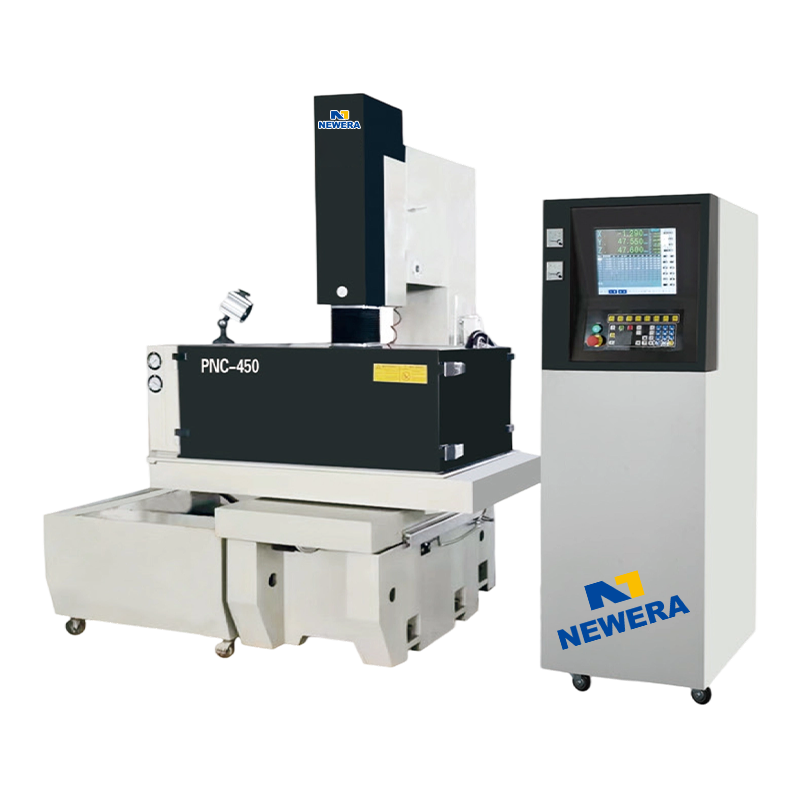
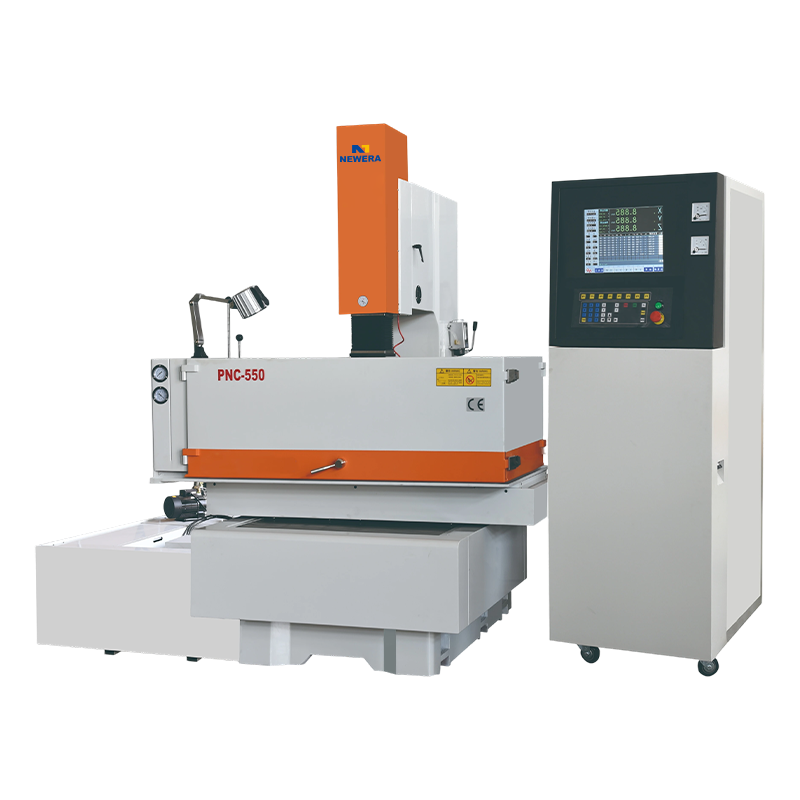
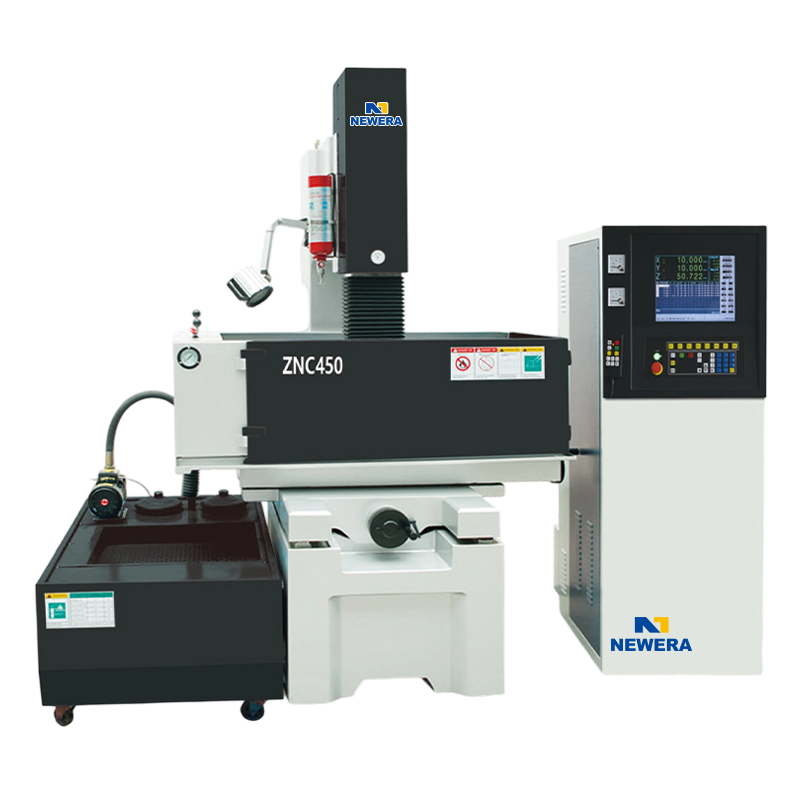
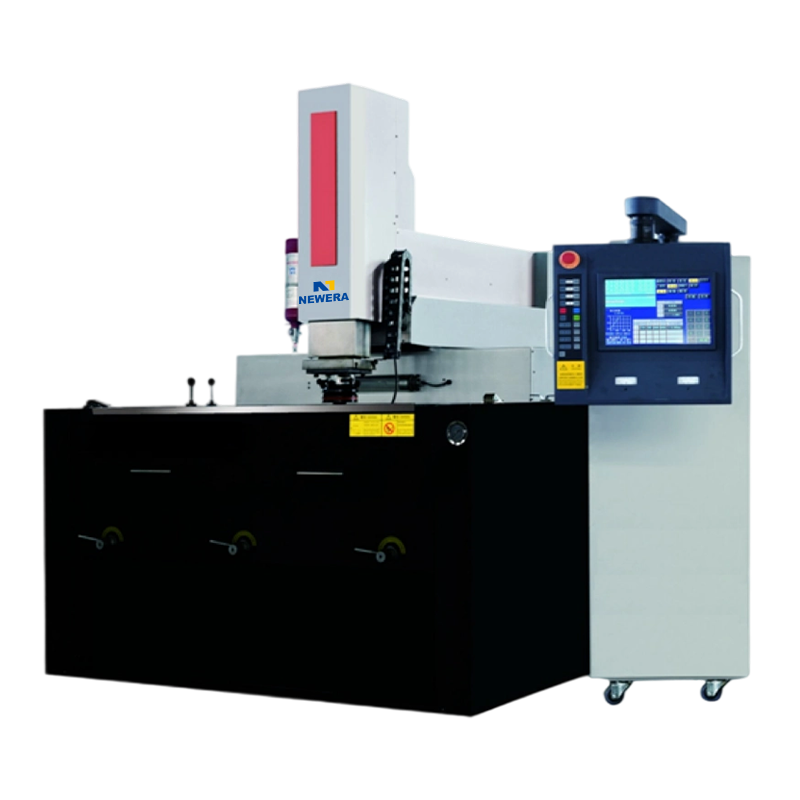
As a professional OEM PNC EDM Die Sinking Machine manufacturer and ODM factory, New Era has developed into a full-capability producer with a complete production and mounting center. Every machine is built to deliver consistent precision EDM machining performance across demanding industrial applications — from high-volume mold making to specialized aerospace and medical tooling.
New Era's commitment is straightforward: provide customers with the best industrial EDM solutions, create maximum value through high-quality products, and support every installation with responsive, expert service. Whether you need a standard CNC die sinking EDM platform or a customized high accuracy EDM equipment configuration, New Era's engineering team works directly with you to match the machine specification to your exact application requirements.
Frequently Asked Questions About PNC EDM Die Sinking Machines


If you are interested in our products, please consult us.
CONTACT DETAILS
Nantong New Era Technology Co., LTD
- Five-star Industrial Park, Chongchuan District, Nantong City, Jiangsu Province, China
- TEL:+86-19851302688
- E-Mail: [email protected]
Products
Quick link
Mobile terminal
