

 русский
 عربى
عربى
Industry News
Why Are 80% Of Mold Manufacturers Switching To CNC EDM Machines?
 2026.05.14
 Industry News
Quick Answer
The overwhelming shift toward CNC EDM machines in mold manufacturing comes down to one core advantage: the ability to achieve micron-level precision on hardened steel without mechanical cutting force. CNC EDM die sinking machines can produce complex 3D cavities, sharp internal corners, and ultra-fine surface finishes that conventional machining simply cannot match — all while running unattended overnight. As mold designs grow more intricate and tolerances tighten, precision EDM machining has become the standard, not the exception.
Content
- 1 The Real Reason Mold Shops Are Replacing Conventional Machines
- 2 How CNC EDM Die Sinking Machines Actually Work
- 3 7 Measurable Advantages of CNC EDM Machines in Mold Production
- 4 EDM Electrode Manufacturing: The Hidden Quality Factor
- 5 Where Precision EDM Machining Is Indispensable
- 6 How to Select the Right CNC EDM Die Sinking Machine for Your Shop
- 7 CNC EDM vs. Conventional Milling: An Honest Comparison
- 8 About Nantong New Era Technology Co., Ltd
- 9 Frequently Asked Questions About CNC EDM Machines
The Real Reason Mold Shops Are Replacing Conventional Machines
A decade ago, CNC EDM machines were considered specialty equipment — reserved for aerospace and medical toolmakers. Today, they are a core production asset in mold shops of every size. Industry surveys show that more than 80% of mold manufacturers now operate at least one CNC EDM die sinking machine, and adoption continues to accelerate as part costs fall and machine intelligence rises.
The driving force is not simply technology preference — it is economic necessity. Modern plastic injection molds, die-casting dies, and rubber molds demand tolerances under ±0.005 mm and surface finishes below Ra 0.2 µm. Achieving these specs on hardened tool steel (HRC 60+) with traditional milling requires repeated annealing, machining, and re-hardening cycles that add days to lead time. Sinker EDM for mold making eliminates that cycle entirely.
Why Mold Manufacturers Choose CNC EDM — Top Drivers (%)
Precision on Hardened Steel
94%
Complex Cavity Geometry
88%
Unmanned Night Operation
79%
Reduced Rework & Scrap
73%
Surface Finish Quality
68%
How CNC EDM Die Sinking Machines Actually Work
A CNC EDM die sinking machine — also called a sinker EDM or ram EDM — uses controlled electrical spark discharges to erode material from a conductive workpiece. A shaped electrode (typically graphite or copper) is brought close to the workpiece in a dielectric fluid bath. Precisely timed sparks jump the microscopic gap, melting and vaporizing tiny particles of metal. The CNC control system manages spark frequency, gap voltage, servo movement, and flushing — all automatically.
Key Process Parameters That Define Output Quality
Discharge Energy (µJ)
Controls material removal rate vs. surface roughness trade-off. Lower energy = finer finish, higher energy = faster roughing.
Gap Servo Control
Adaptive servo maintains the ideal inter-electrode gap in real time, preventing short circuits and maximizing stability.
Dielectric Flushing
EDM oil or deionized water flushes debris from the gap. Optimized flushing prevents re-deposition and improves accuracy.
Orbital Motion (Orbiting)
Programmable electrode orbiting improves lateral flushing, reduces taper, and produces more uniform cavity walls.
Because no cutting force contacts the workpiece, fragile features, thin walls, and pre-hardened steel can all be processed without deformation — a capability that sets precision EDM machining apart from any other metal-removal process.
7 Measurable Advantages of CNC EDM Machines in Mold Production
1. Machining Hardened Steel Without Annealing
Tool steels at HRC 58–65 — P20, H13, D2, S136 — are machined directly by sinker EDM for mold making with no need to soften and re-harden the material. This saves 2–5 days per mold and eliminates heat-treatment distortion risk.
2. True Sharp Internal Corners
Milling tools always leave a radius in internal corners equal to the tool radius. CNC EDM die sinking machines produce true 90° internal corners (or any radius down to 0.05 mm), critical for parting line fit and gate geometry in injection molds.
3. Mirror-Level Surface Finish
High accuracy EDM machines achieve surface roughness values of Ra 0.05–0.2 µm in finishing mode — equivalent to polished mirror surfaces. This directly reduces or eliminates manual polishing time, which can account for 30–40% of total mold manufacturing hours.
4. Complex 3D Cavity Shapes
By using shaped EDM electrodes manufactured to the exact negative geometry of the desired cavity, virtually any 3D shape can be sunk into the workpiece. Undercuts, stepped cavities, and intricate texturing patterns are achievable in a single setup.
5. Repeatability Across Multiple Cavities
Multi-cavity molds require every cavity to match within ±0.002 mm. Modern CNC EDM machines with linear scale feedback and thermal compensation deliver cavity-to-cavity consistency that manual and semi-manual methods cannot sustain across production runs.
6. Automated Unmanned Operation
A properly programmed CNC EDM die sinking machine can run unattended for 8–16 hours. With automatic electrode changers (ATC) and pallet systems, a single operator can supervise multiple machines simultaneously, dramatically improving labor efficiency.
7. Micro Hole EDM Drilling Capability
Dedicated micro hole EDM drilling attachments or standalone EDM hole-popping machines drill through-holes as small as 0.1 mm in hardened steel. These cooling holes, ejector pin holes, and venting channels are impossible to drill conventionally at such small diameters without breakage.
EDM Electrode Manufacturing: The Hidden Quality Factor
The quality of the EDM electrode determines the quality of the finished cavity. EDM electrode manufacturing is therefore a precision process in its own right. Graphite electrodes are the most common choice, offering high machinability, low thermal expansion, and excellent wear resistance at elevated spark temperatures. Copper electrodes are preferred for fine finishing applications where the lowest possible surface roughness is required.
Graphite vs. Copper Electrodes — Quick Comparison
| Property | Graphite | Copper |
|---|---|---|
| Machining Speed (electrode) | Fast | Moderate |
| EDM Material Removal Rate | High | Moderate |
| Surface Finish (Ra) | Ra 0.2–0.8 µm | Ra 0.05–0.4 µm |
| Electrode Wear Rate | Low–Moderate | Very Low |
| Best Use Case | Roughing, large cavities | Finishing, micro detail |
Most professional mold shops use a multi-electrode strategy: one or two roughing graphite electrodes followed by a finishing copper electrode per cavity. This approach balances speed with final surface quality and is a standard workflow supported by modern CNC EDM machine programming software.
Where Precision EDM Machining Is Indispensable
While CNC EDM die sinking machines are used across manufacturing, there are specific application areas where they are truly irreplaceable. These represent the highest-value use cases driving adoption in mold shops globally.
Plastic Injection Molds
Gate inserts, runner systems, textured cavity walls, and side-action cores all benefit from sinker EDM's no-force, high-finish capability.
Die-Casting Dies
H13 tool steel dies for aluminum, zinc, and magnesium die casting require complex water cooling channels and high-wear surface treatment — both achievable with EDM.
Stamping & Progressive Dies
Punch and die sections for thin-sheet metal forming demand sharp edges and tight clearances. CNC EDM machines produce these features in D2 and M2 steels reliably.
Medical & Optical Components
Micro-scale features on surgical instrument molds and optical lens mold inserts require the sub-micron precision that only high accuracy EDM machines provide.
Aerospace Turbine Components
Micro hole EDM drilling creates thousands of cooling holes in turbine blades from Inconel and titanium — diameters below 0.3 mm, depths over 20× diameter.
Rubber & LSR Molds
Flash-free parting line geometry in liquid silicone rubber molds requires fits within ±0.003 mm — a specification that practically mandates precision EDM machining.
CNC EDM Adoption Rate by Mold Sector (2019–2024, %)
How to Select the Right CNC EDM Die Sinking Machine for Your Shop
Not all sinker EDM machines are equal. Selecting the right high accuracy EDM machine requires matching machine specifications to your actual workpiece requirements — not buying on brand recognition alone. Consider these critical selection factors:
- Working Tank Dimensions: Ensure the X/Y/Z travel and maximum workpiece weight capacity match your largest planned mold base size. Buying undersized forces outsourcing of large work.
- Generator Technology: Look for digital adaptive pulse generators (as opposed to RC or transistor types) that automatically optimize spark parameters per material and electrode combination.
- Positioning Accuracy: For mold work, seek machines with positioning accuracy of ±0.001 mm or better, and repeatability under ±0.002 mm — verified by linear scale feedback, not just ballscrew pitch.
- Orbital Function: A fully programmable 3D orbital motion function is essential for finishing complex cavities and achieving uniform sidewall texture.
- Automatic Electrode Changer (ATC): For unmanned operation and multi-electrode strategies, ATC compatibility transforms a stand-alone machine into a flexible manufacturing cell.
- Thermal Stability: Machines with temperature-compensated columns and dielectric temperature control maintain accuracy regardless of workshop ambient temperature variation.
Shops new to precision EDM machining should also verify that the supplier offers application engineering support — particularly for first-time electrode design, burn parameter setup, and dielectric system maintenance, which are the primary learning curve challenges.
CNC EDM vs. Conventional Milling: An Honest Comparison
CNC EDM machines do not replace milling for every operation. Understanding where each process adds the most value is the foundation of a productive mold shop workflow.
| Criteria | CNC EDM | CNC Milling |
|---|---|---|
| Hardened Steel (HRC 60+) | Excellent | Poor |
| Internal Corner Radius | Any (0.05mm+) | ≥ Tool radius |
| Material Removal Rate | Moderate | High |
| Surface Roughness (best) | Ra 0.05 µm | Ra 0.4–0.8 µm |
| Cutting Force on Workpiece | Zero | High |
| Thin Wall / Fragile Feature | Safe | Risk of deflection |
| Electrode / Tooling Cost | Electrode per job | Standard end mills |
About Nantong New Era Technology Co., Ltd
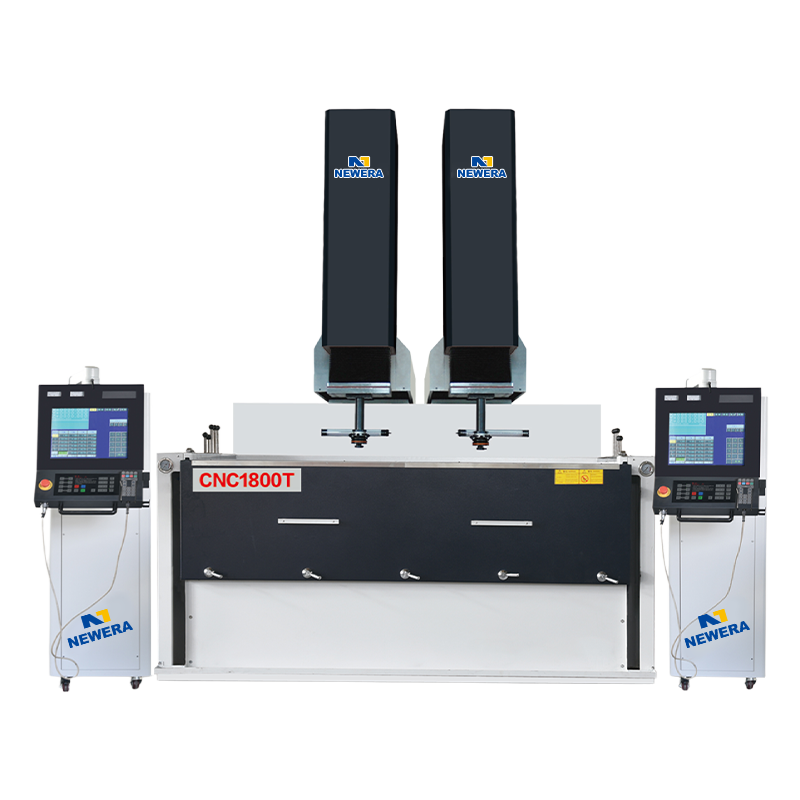
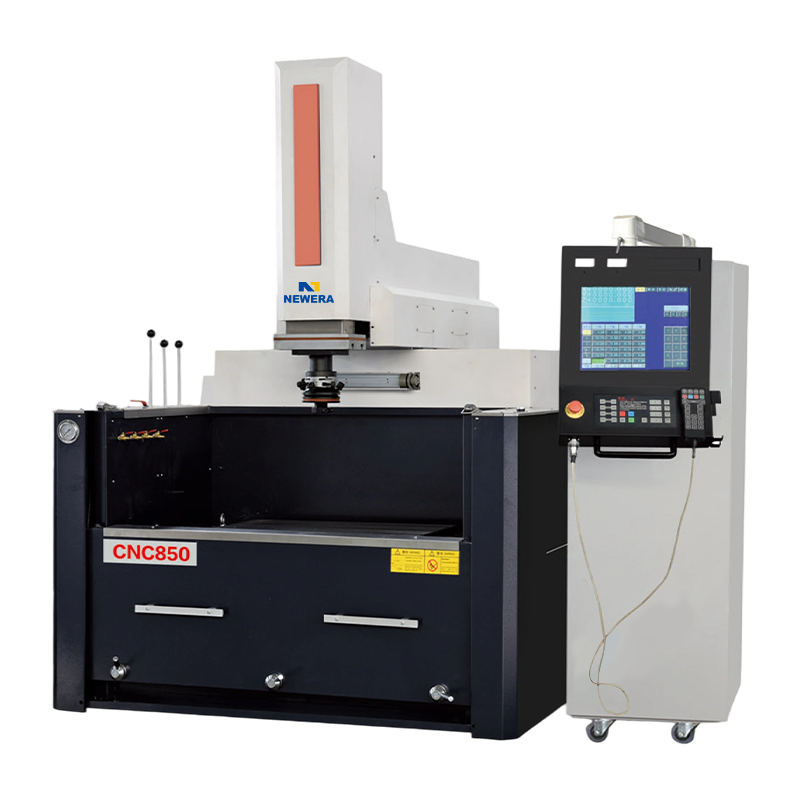
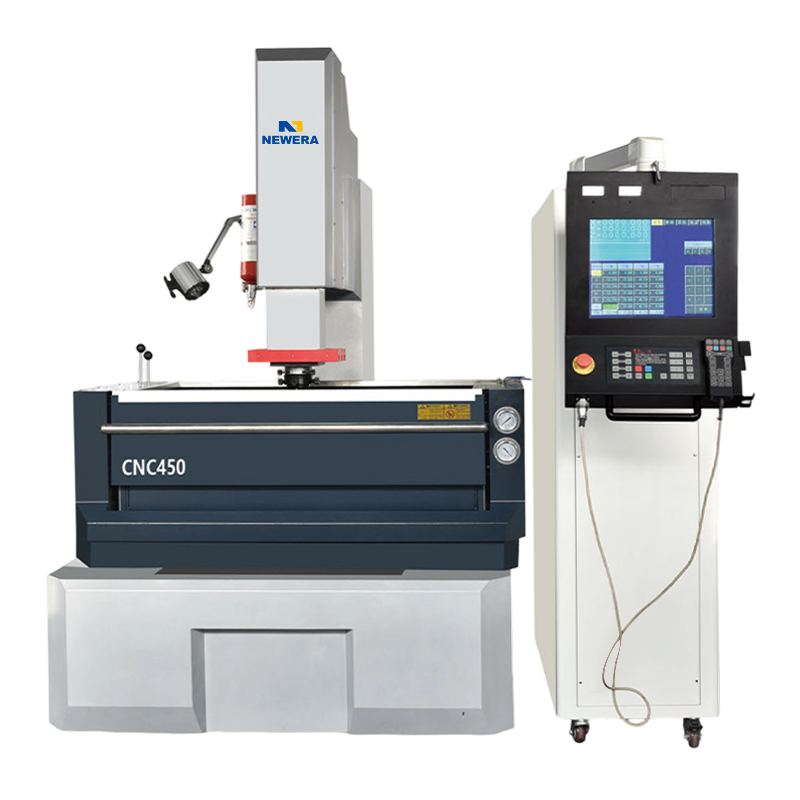
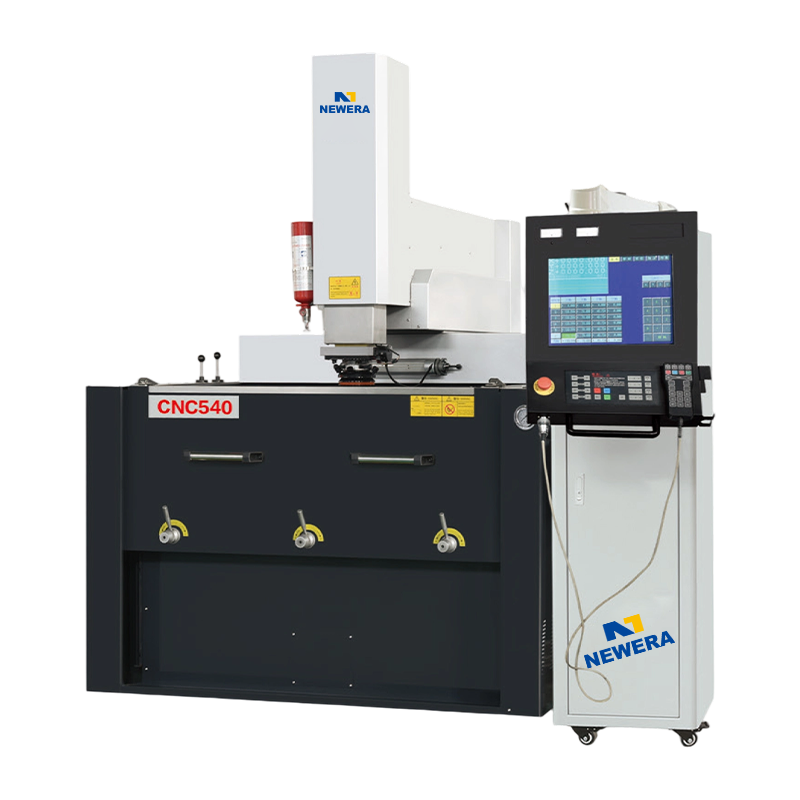
Nantong New Era Technology Co., Ltd specializes in developing, designing, and producing numerical control machines and CNC machine tools for more than 20 years. With a professional team dedicated to technology development, manufacturing, and sales services, New Era has built a reputation as a trusted source for advanced CNC EDM solutions.
As a professional OEM CNC EDM Die Sinking Machine supplier and ODM CNC EDM machine factory, New Era continuously incorporates the latest scientific and technological achievements from both domestic and international sources. The company has grown into a professional manufacturer with a complete production and assembly center — offering end-to-end capability from engineering design through final commissioning.
New Era's commitment is straightforward: provide customers with the best solutions and create maximum value through high-quality products and comprehensive after-sales service. Whether you need a standard sinker EDM for mold making or a customized high accuracy EDM machine for specialized applications, New Era has the experience and manufacturing capacity to deliver.
Frequently Asked Questions About CNC EDM Machines
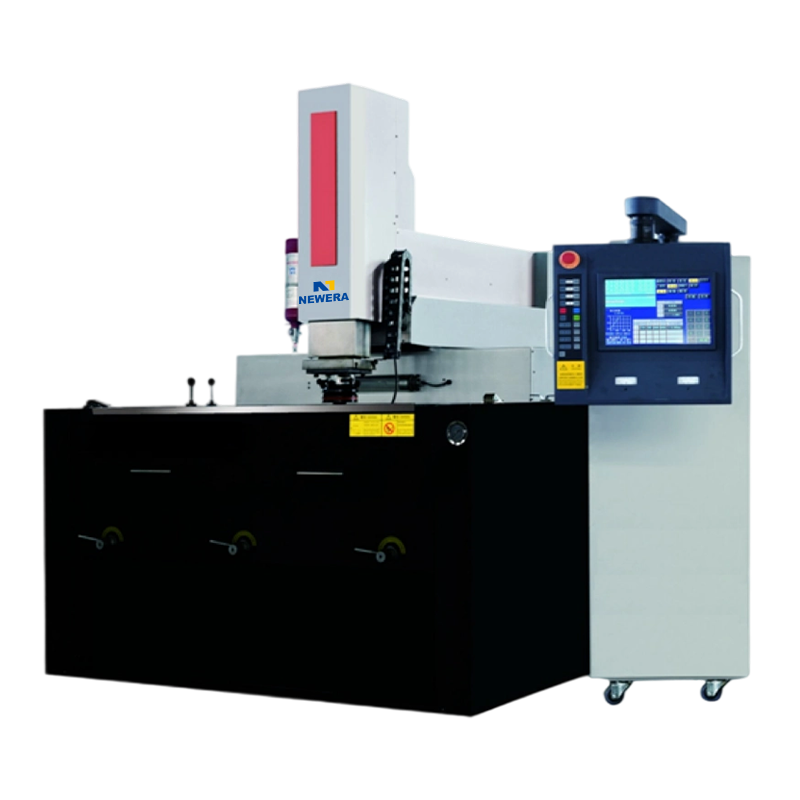
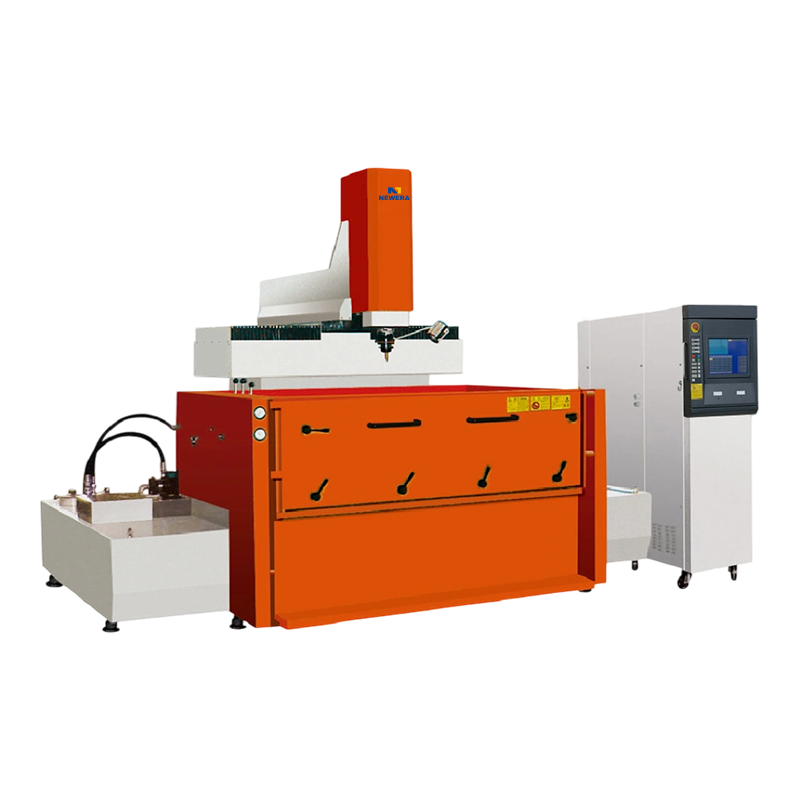
If you are interested in our products, please consult us.
CONTACT DETAILS
Nantong New Era Technology Co., LTD
- Five-star Industrial Park, Chongchuan District, Nantong City, Jiangsu Province, China
- TEL:+86-19851302688
- E-Mail: [email protected]
Products
Quick link
Mobile terminal
