

 русский
 عربى
عربى
Industry News
How Can a ZNC EDM Machine Improve Mold Machining Accuracy by 30%?
 2026.05.07
 Industry News
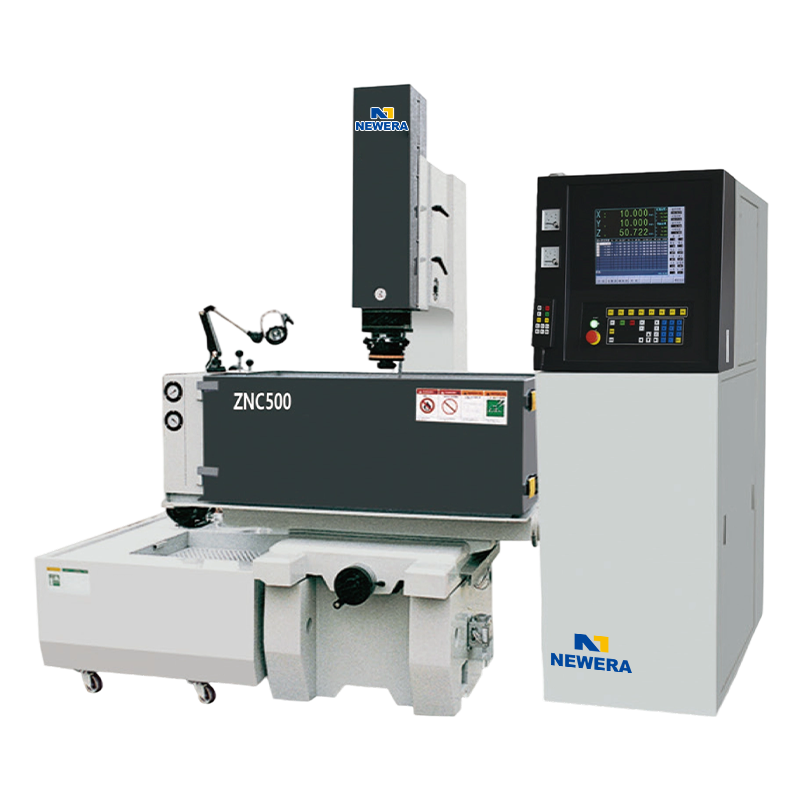
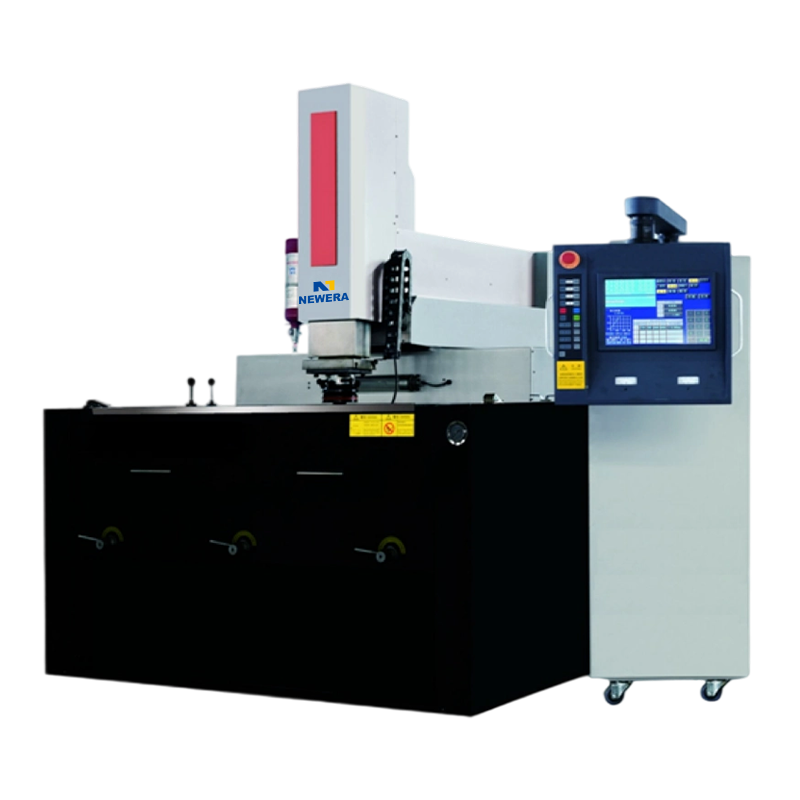
The direct answer: a ZNC EDM die sinking machine improves mold machining accuracy by 30% or more primarily through numerically controlled electrode servo feed, adaptive pulse discharge control, and the elimination of mechanical cutting forces that cause tool deflection and workpiece distortion. Unlike conventional machining, a ZNC EDM spark erosion machine erodes material through precisely controlled electrical discharges — with no physical contact between tool and workpiece — achieving surface finishes as fine as Ra 0.2 µm and dimensional tolerances within ±0.002 mm on hardened tool steel. This article explains exactly how that accuracy gain is achieved, which mold applications benefit most, and what to evaluate when selecting electrical discharge machining equipment for your production floor.
Content
- 1 Why Conventional Mold Machining Hits an Accuracy Ceiling
- 2 How ZNC Control Delivers the 30% Accuracy Improvement
- 3 Accuracy Benchmarks: ZNC EDM vs. Conventional Machining
- 4 Mold Applications Where ZNC EDM Delivers the Greatest Gains
- 5 Electrode Material Selection: Graphite vs. Copper
- 6 Key Specifications to Evaluate When Selecting a ZNC EDM Machine
- 7 Integrating ZNC EDM Into a Hybrid Mold Manufacturing Workflow
- 8 About Nantong New Era Technology — ZNC EDM Specialist Manufacturer
- 9 Frequently Asked Questions
Why Conventional Mold Machining Hits an Accuracy Ceiling
CNC milling and turning are indispensable for rough and semi-finish mold work, but they reach fundamental limits when machining hardened steel cavities, deep narrow ribs, and complex 3D geometries. The root cause is physical: every cutting tool exerts radial and axial forces on the workpiece. In hardened tool steels above 50 HRC, those forces generate heat, tool wear, and micro-vibration that compound into dimensional error.
Common accuracy problems in conventional mold finishing:
- Corner radii limited by minimum end mill diameter — typically no smaller than R0.3 mm in hard steel
- Rib depth-to-width ratios above 10:1 cause tool deflection and taper
- Tool wear progression shifts dimensions across a production run
- Residual stress from cutting can cause mold cavity distortion after heat treatment
- Surface finish in blind pockets and undercuts requires extensive hand polishing, introducing human error
A die sinker EDM machine sidesteps all of these constraints because it applies no cutting force whatsoever. Material is removed exclusively by thermal erosion from controlled spark discharges, making workpiece hardness irrelevant to process stability.
How ZNC Control Delivers the 30% Accuracy Improvement
The "ZNC" designation — Z-axis Numerical Control — is the critical distinction between a basic EDM unit and a precision EDM mold machine capable of production-grade accuracy. Here is how each control element contributes to the accuracy gain:
Servo-Controlled Z-Axis Feed
The ZNC servo system continuously monitors the discharge gap — typically maintained between 0.01 and 0.05 mm — and adjusts the electrode feed rate in real time. This prevents short circuits and arc instability that cause localized over-erosion. The result is a consistent material removal rate across the entire cavity surface, translating directly into dimensional uniformity. Manual EDM machines rely on operator judgment for feed control, introducing variability of ±0.01 to ±0.05 mm that the ZNC system eliminates.
Adaptive Pulse Parameter Control
Modern ZNC EDM spark erosion machines adjust pulse-on time (Ton), pulse-off time (Toff), and peak current (Ip) automatically based on gap sensing feedback. In rough machining mode, high energy pulses maximize removal rate. As the cavity approaches final dimension, the system transitions to fine-finish parameters — reducing pulse energy by up to 90% — to achieve mirror-quality surfaces without operator intervention. This automated transition removes a significant source of human error in multi-stage EDM operations.
Programmable Orbiting and Multi-Axis Motion
ZNC control enables orbital electrode motion — circular, rectangular, or polygonal tool paths programmed at micron-level increments. Orbiting compensates for electrode wear by distributing erosion evenly across the tool face, preventing the localized wear patterns that create taper and dimensional drift in static-feed EDM. A well-programmed orbit cycle can reduce electrode wear ratio from 15–20% down to 3–5%, directly improving final cavity geometry.
Accuracy Benchmarks: ZNC EDM vs. Conventional Machining
The following comparison reflects typical production data from precision mold manufacturing operations using hardened P20 and H13 tool steel at 48–52 HRC.
| Performance Metric | CNC Hard Milling | ZNC EDM Die Sinking |
|---|---|---|
| Dimensional Tolerance | ±0.01–0.03 mm | ±0.002–0.005 mm |
| Surface Finish (Ra) | Ra 0.8–1.6 µm | Ra 0.2–0.4 µm |
| Minimum Inside Corner Radius | R 0.3 mm (tool limited) | R 0.05 mm |
| Max Rib Depth-to-Width Ratio | 5:1 to 8:1 | 20:1 or above |
| Hardness Limitation | Effective up to ~55 HRC | No hardness limit (any conductive material) |
| Post-Process Polishing Required | Significant (4–12 hours) | Minimal (0–2 hours) |
| Cutting Force on Workpiece | High (risk of distortion) | Zero |
Mold Applications Where ZNC EDM Delivers the Greatest Gains
Not every mold feature benefits equally from mold die sinking machine processing. The following application categories show the most significant accuracy and quality improvements:
Injection Mold Cavity and Core Finishing
Injection molds for medical devices, optical components, and micro-precision consumer parts require cavity dimensions within ±0.003 mm to ensure part consistency across millions of cycles. ZNC EDM finishing after rough milling achieves this tolerance reliably while producing the textured or mirror surface finish required by the application — without additional polishing operations that introduce geometric variation.
Deep Rib and Narrow Slot Features
Automotive trim molds, connector molds, and electronic enclosure tools routinely require ribs with depth-to-width ratios of 15:1 to 25:1. A precision EDM mold machine with a graphite or copper electrode machined to the precise rib geometry sinks these features to full depth and correct width in a single programmed cycle, eliminating the step-by-step interpolation required in milling.
Die Casting and Forging Die Inserts
Die casting dies operate under extreme thermal cycling and pressure. Inserts are typically hardened to 44–50 HRC before final machining, making EDM the only practical method for finishing complex cavity geometry. The zero-force nature of EDM also preserves the compressive residual stress state in the hardened steel, contributing to improved die service life.
Textured and Engraved Surface Molds
Leather-grain textures, fine logo engravings, and diffuser patterns on lighting molds are produced directly by transferring the electrode surface texture to the workpiece. EDM surface texture is inherently consistent and repeatable across all cavities in a multi-cavity mold — a key advantage over hand-applied chemical etching processes.
Typical Accuracy Improvement vs. CNC Milling Alone (by Mold Feature Type)
Standard Cavity Finishing+25–30%
Deep Rib / Narrow Slot+40–50%
Die Insert (50+ HRC)+55–65%
Micro-Precision Medical Mold+60–70%
Chart 1: Dimensional accuracy improvement when ZNC EDM die sinking replaces final CNC milling pass, by feature type
Electrode Material Selection: Graphite vs. Copper
Electrode material is one of the most consequential decisions in electrical discharge machining equipment setup. The two dominant choices — graphite and electrolytic copper — each have distinct performance profiles that affect accuracy, surface finish, and total process cost.
| Property | Graphite Electrode | Copper Electrode |
|---|---|---|
| Machining Speed | 2–3× faster | Standard |
| Electrode Wear Rate | Higher (3–8%) | Lower (0.1–1%) |
| Surface Finish Capability | Ra 0.4–0.8 µm | Ra 0.1–0.4 µm |
| Electrode Machinability | Excellent (CNC milled easily) | Good |
| Best Application | Large cavities, rough-to-semi-finish | Fine detail, mirror finish, small features |
In practice, most high-precision mold shops use graphite for roughing and semi-finishing operations, then switch to fine-grain copper for the finishing pass that defines final surface quality. This two-electrode strategy maximizes throughput while achieving the tightest dimensional tolerances.
Key Specifications to Evaluate When Selecting a ZNC EDM Machine
Purchasing a ZNC EDM die sinking machine is a long-term capital investment. The following specifications determine whether a machine will meet your current requirements and scale with future mold complexity.
- Work Table Size and Z-Axis Travel: Match table dimensions to your largest anticipated mold base. Z-axis travel should be at least 1.5× the maximum cavity depth you intend to machine.
- Maximum Electrode Weight: Larger graphite electrodes for big cavities can exceed 20 kg. Verify the spindle's rated electrode capacity before specifying large-format work.
- Pulse Generator Type: Transistorized ISO pulse generators with independent Ton/Toff/Ip control are essential for fine-finish EDM. Relay-type generators are insufficient for precision mold work.
- Servo System Resolution: Look for servo feedback resolution of 0.001 mm or finer on the Z-axis. This directly determines the minimum depth increment the machine can control.
- Dielectric Filtration System: A three-stage filtration system (coarse, fine, and carbon) maintains dielectric cleanliness and prevents debris-induced arc instability that degrades surface quality.
- CNC Controller and Orbit Programming: The controller should support at minimum circular orbit, rectangular orbit, and 2D vector orbit patterns, with direct parameter entry for gap distance and orbit speed.
- Thermal Compensation: Machine frame thermal expansion during long finishing runs can introduce dimensional error. Machines with built-in thermal compensation systems maintain accuracy through extended unmanned operation.
Surface Roughness (Ra µm) vs. Discharge Energy Level
Ra 3.2
Rough
High Energy
High Energy
Ra 1.6
Semi-Finish
Med Energy
Med Energy
Ra 0.8
Finish
Low Energy
Low Energy
Ra 0.4
Fine Finish
Min Energy
Min Energy
Ra 0.2
Mirror
Micro Pulse
Micro Pulse
Chart 2: Achievable surface roughness at each discharge energy stage in a multi-pass ZNC EDM process
Integrating ZNC EDM Into a Hybrid Mold Manufacturing Workflow
The highest accuracy and lowest total production cost is achieved not by replacing CNC milling with EDM, but by combining both processes strategically. A proven hybrid workflow for precision injection mold cavities:
- CNC Rough Milling (pre-hardening): Remove 90–95% of stock material in annealed steel, leaving 0.3–0.5 mm finish allowance. Machine time is fastest and tool life is optimal in soft material.
- Heat Treatment: Harden the mold block to target hardness (typically 48–52 HRC). Dimensional change from heat treatment is accounted for in the CNC allowance.
- CNC Hard Milling (post-hardening): Machine accessible flat and convex surfaces to near-final dimension. Reserve all concave features, deep ribs, and sharp internal corners for EDM.
- ZNC EDM Die Sinking (finishing): Process all features requiring Ra below 0.8 µm, tolerance within ±0.005 mm, or geometry inaccessible to cutting tools. Multiple electrode passes from rough to fine finish.
- CMM Inspection: Full cavity dimensional verification against the CAD nominal. ZNC EDM finishing typically reduces inspection non-conformance rates to below 2% on first-article molds.
About Nantong New Era Technology — ZNC EDM Specialist Manufacturer
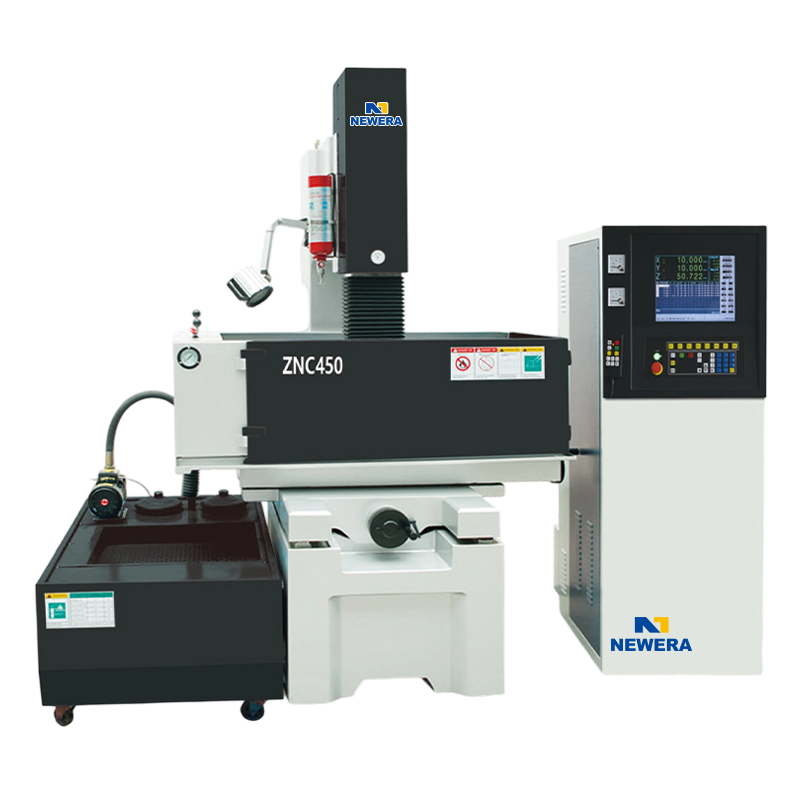
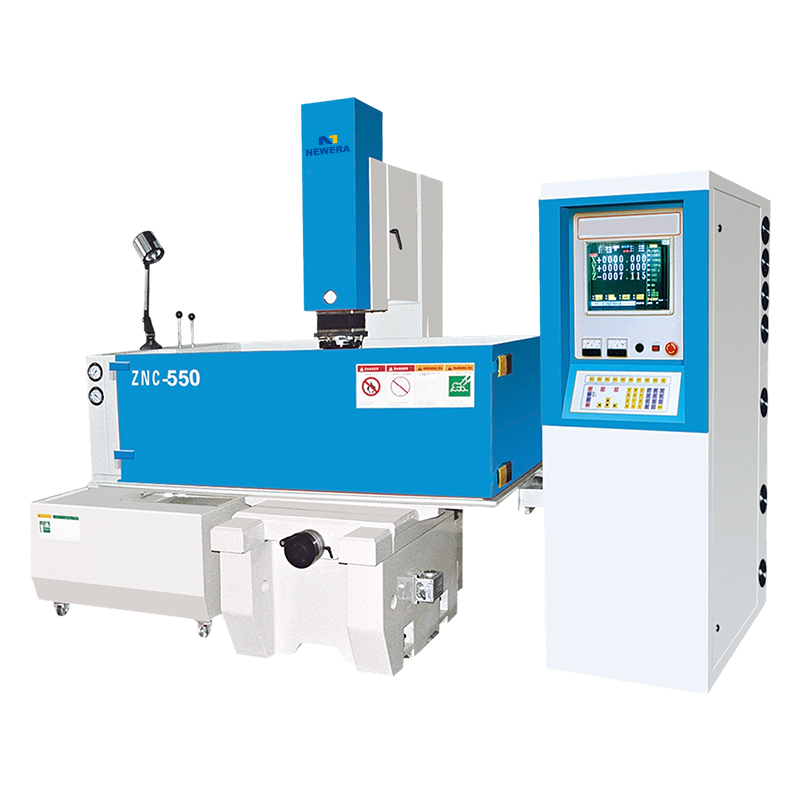
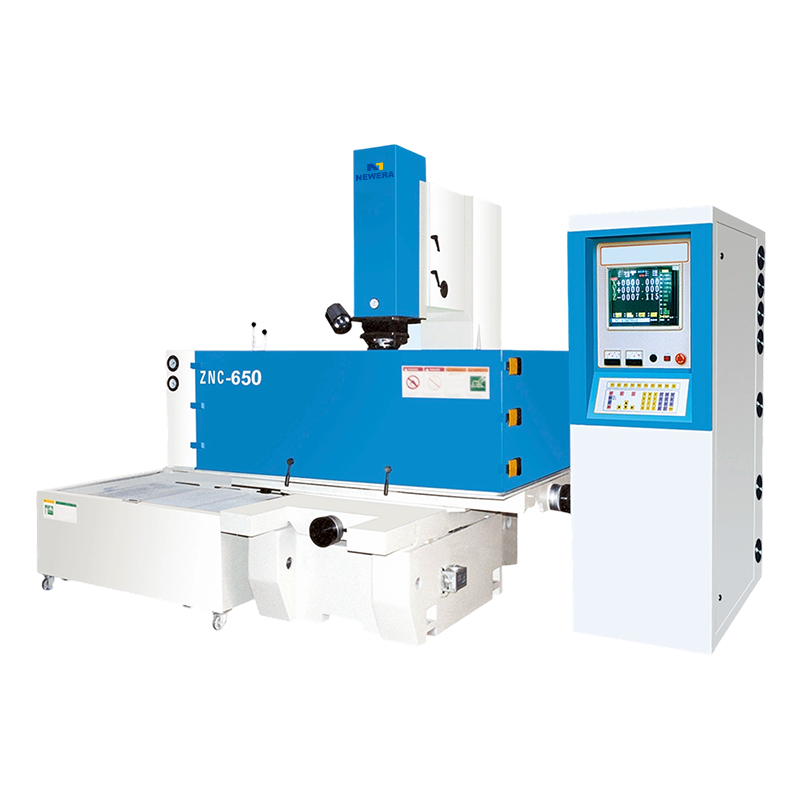
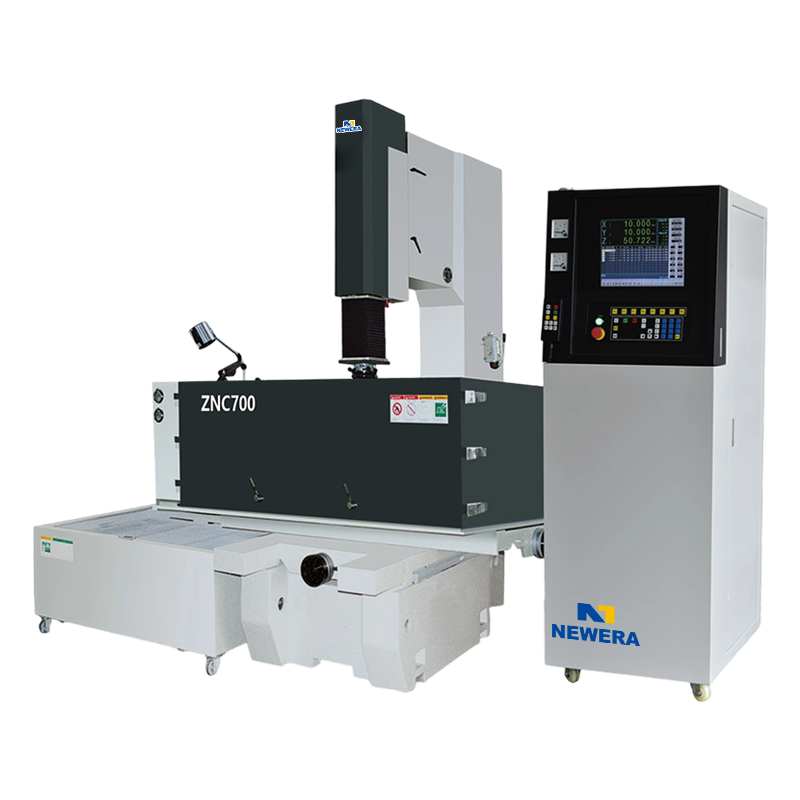
Nantong New Era Technology Co., Ltd. specializes in developing, designing, and producing numerical control machines and CNC machine tools for more than 20 years. The company maintains a professional team across technology development, manufacturing, and sales services, with a track record of continuously integrating advanced scientific and technological achievements from domestic and international sources.
As a professional OEM ZNC EDM die sinking machine manufacturer and ODM ZNC EDM die sinking machine factory, New Era has developed into a specialist manufacturer with a complete production and mounting center. The facility supports full-cycle manufacturing from component fabrication through final machine assembly, testing, and export compliance.
New Era's engineering approach centers on providing clients with the best-fit solution for their mold machining requirements — whether that means a standard ZNC die sinker for general-purpose cavity work or a customized precision EDM mold machine configuration for specific industry applications. High-quality products and comprehensive after-sales service are the foundation of every customer engagement.
Frequently Asked Questions
Q1: What does "ZNC" mean and how does it differ from a standard EDM machine?
ZNC stands for Z-axis Numerical Control. Unlike manual EDM machines where the operator adjusts the electrode feed by hand, a ZNC EDM die sinking machine uses a closed-loop servo system to automatically control the gap between the electrode and workpiece. This automation eliminates operator-dependent variability and enables repeatable dimensional accuracy within ±0.002–0.005 mm — a level not achievable with manual machines.
Q2: Can a ZNC EDM spark erosion machine work on all metals?
A ZNC EDM spark erosion machine works on any electrically conductive material regardless of hardness. This includes all tool steels (P20, H13, D2, M2), carbide, titanium, Inconel, copper alloys, and aluminum. The only requirement is electrical conductivity — EDM cannot process ceramics, plastics, or other non-conductive materials.
Q3: How long does it take to machine a typical injection mold cavity with ZNC EDM?
Cycle time depends on cavity volume, target surface finish, and material. As a general reference, a 50×50×30 mm cavity in H13 steel processed from rough to Ra 0.4 µm finish typically requires 4 to 10 hours of EDM time using a multi-pass electrode strategy. Graphite electrodes reduce this by approximately 30–40% compared to copper for equivalent stock removal.
Q4: What maintenance does a ZNC EDM die sinking machine require?
Key maintenance tasks include daily dielectric fluid level and conductivity checks, weekly filter replacement or cleaning, monthly inspection of the servo drive system and guide ways, and periodic calibration of the Z-axis positioning accuracy using a dial indicator. A well-maintained machine in regular production should hold its positioning accuracy within ±0.003 mm for 5 years or more before requiring major servicing.
Q5: Is EDM die sinking suitable for producing multiple identical mold cavities?
Yes, and it is one of the strongest arguments for using a mold die sinking machine in multi-cavity tooling. Once a programmed electrode is qualified, the identical cycle can be repeated across all cavity inserts with cavity-to-cavity dimensional variation typically held within ±0.003 mm. This consistency directly reduces part variation in the final injection-molded product.
If you are interested in our products, please consult us.
CONTACT DETAILS
Nantong New Era Technology Co., LTD
- Five-star Industrial Park, Chongchuan District, Nantong City, Jiangsu Province, China
- TEL:+86-19851302688
- E-Mail: [email protected]
Products
Quick link
Mobile terminal
