

 русский
 عربى
عربى
Industry News
How to Choose the Right EDM Machine?
 2026.06.11
 Industry News
The right CNC EDM die sinking machine can be the difference between consistent, high-accuracy mold production and costly rework cycles. If you need a direct answer: match your machine to your electrode material, workpiece hardness, required surface finish (Ra value), and table travel range — in that order. Everything else follows from those four parameters.
This guide is written for production engineers, toolroom managers, and procurement teams evaluating a precision EDM machine factory or die sinking EDM machine supplier. It covers the technical criteria, application-specific selection logic, and operational factors that determine which machine model fits your workflow — from small CNC EDM die sinking machines for prototype toolrooms to fully automatic systems for high-volume injection mold manufacturing.
The global EDM machine market is growing steadily, driven by increasing demand for tight-tolerance mold cavities in automotive, aerospace, and consumer electronics sectors. Understanding how to evaluate a CNC EDM machine for hardened steel or a graphite electrode EDM machine before purchasing will save time, reduce scrap rates, and extend machine service life well beyond the warranty period.
Content
- 1 What Is a CNC EDM Die Sinking Machine and How Does It Work
- 2 Core Selection Criteria for Choosing the Right EDM Machine
- 3 EDM Machine Model Comparison: PNC Series Overview
- 4 Application-Specific EDM Machine Selection by Industry
- 5 Surface Finish Standards and What They Mean for Mold Quality
- 6 Dielectric System and Flushing: Often Overlooked but Critical
- 7 Evaluating a CNC EDM Machine Manufacturer: What to Look For
- 8 Pre-Purchase Checklist for EDM Machine Buyers
- 9 Frequently Asked Questions
What Is a CNC EDM Die Sinking Machine and How Does It Work
A CNC EDM die sinking machine — also called a sinker EDM, ram EDM, or cavity-type EDM — removes material from a conductive workpiece through controlled electrical discharge erosion. A shaped electrode (typically graphite or copper) is fed toward the workpiece while a dielectric fluid (usually hydrocarbon oil) flows between them. Thousands of precisely timed electrical sparks per second vaporize microscopic amounts of workpiece material, progressively replicating the electrode shape as a cavity in the target part.
Unlike conventional cutting, EDM applies no mechanical force to the workpiece, making it uniquely suited for hardened steel machining, thin-wall cavities, and complex three-dimensional profiles that would deflect or fracture under milling. The process is equally effective on any electrically conductive material — from tool steel at 60 HRC to tungsten carbide — regardless of hardness, a capability that defines the EDM machine's essential role in injection mold manufacturing and precision tooling.
CNC control transforms what was once a manually supervised process into a repeatable, programmable production operation. Modern CNC sinker EDM machines integrate multi-axis servo positioning, adaptive pulse generators, and automatic tooling change systems — enabling unattended overnight runs and consistent cavity quality across high-volume mold batches.
EDM Die Sinking Process: Key Stages
The five-stage cycle illustrated above repeats continuously during an EDM operation, with the CNC generator automatically adjusting pulse parameters at each stage to optimize material removal rate and surface quality simultaneously. In modern high precision EDM machines, this adaptive control can shift between roughing and finishing discharge conditions within the same program run — a feature that significantly reduces total machining time compared to older fixed-parameter generators. The ability to execute this cycle thousands of times per second while maintaining dimensional stability is what separates a quality industrial EDM machine from a basic entry-level unit.
Core Selection Criteria for Choosing the Right EDM Machine
Selecting the correct machine from a CNC EDM die sinking machine manufacturer's lineup requires evaluating several interdependent technical parameters. Optimizing for only one dimension — such as table size or maximum current — without considering the full picture leads to underperforming equipment choices that create production bottlenecks.
Table Travel and Workpiece Envelope
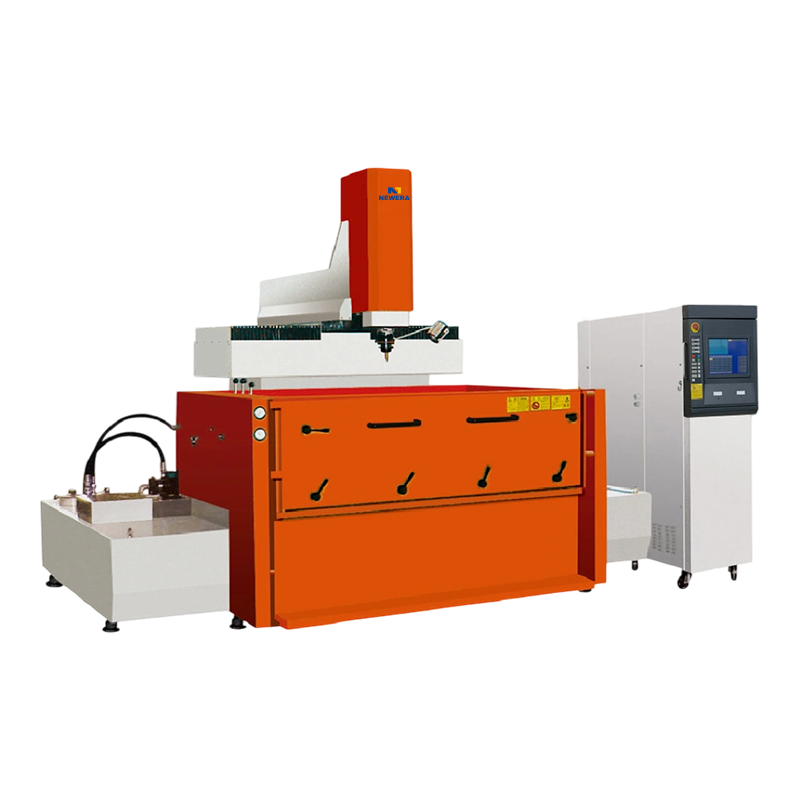
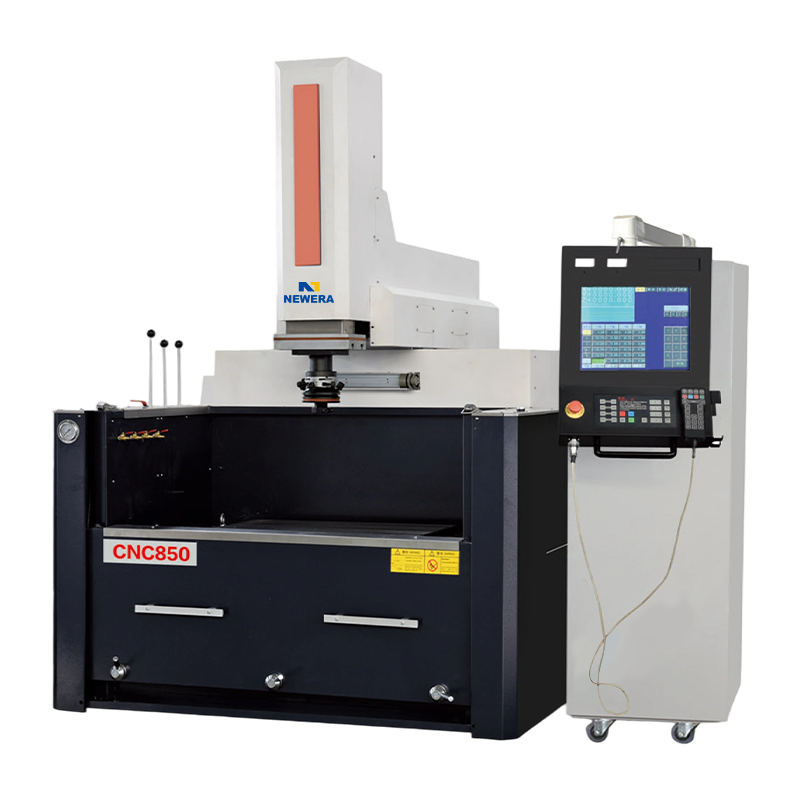
The X/Y/Z axis travel range must comfortably accommodate the largest mold or tooling component you process. A common error is selecting a machine whose maximum table travel exactly matches the largest planned workpiece — leaving no clearance for fixturing and electrode approach paths. As a practical guideline, plan for the workpiece to occupy no more than 70–75% of the table's usable travel range. The PNC series machines offer a range of work tank and table configurations: the PNC 350 suits compact toolroom and prototype work, while the PNC 500 and PNC 550 models address larger cavity molds and multi-impression tooling.
Generator Power and Material Removal Rate
The pulse generator is the heart of the high precision die sinking EDM machine. Generator peak current (measured in amperes) determines the maximum material removal rate (MRR), while pulse width and frequency control surface roughness. For CNC EDM machines for hardened steel, a generator capable of fine-finish settings below Ra 0.4 μm is essential for cavities that will be used in polished injection molds. Roughing operations in large mold cavities may demand peak currents of 60–80 A, while precision finishing on optical or medical mold surfaces operates at 2–8 A.
Electrode Material Compatibility
Electrode material profoundly affects cutting efficiency, wear ratio, and achievable surface quality. Graphite electrode EDM machines are optimized for high-speed rough machining with minimal electrode wear, making them the standard choice for large steel mold cavities. Copper electrodes are preferred for fine-detail work where sharp edge definition is critical. A machine's generator and adaptive control system must be tuned to the electrode material in use — not all machines perform equally with both graphite and copper. Confirm with the precision EDM machine factory whether their control system includes dedicated graphite and copper machining modes.
Automatic Electrode Changer (ATC) Integration
For high-volume mold making EDM machine applications, an EDM machine with automatic electrode changer capability is a significant productivity multiplier. ATC systems store multiple pre-measured electrodes and swap them automatically based on programmed wear limits or machining sequences — enabling continuous unattended operation through roughing, semi-finishing, and finishing stages without operator intervention. In a typical automotive mold production scenario, ATC-equipped machines achieve 40–60% higher spindle utilization compared to manually changed electrode setups.
Impact of Key Machine Features on Production Efficiency (%)
Estimated production efficiency gains associated with each advanced machine feature in a typical mold shop environment.
The chart above quantifies the efficiency contribution of each major machine feature based on typical mold manufacturing performance data. Automatic electrode changing delivers the largest single efficiency gain — over 55% — because it directly addresses the most time-consuming manual intervention in a multi-stage EDM program. The adaptive pulse generator ranks second at 48%, reflecting its ability to autonomously optimize discharge conditions without operator adjustment between roughing and finishing passes. Together, these two features account for the majority of productivity difference between basic and advanced automatic tooling EDM machines, and should be the primary technology priorities for any facility running more than one shift per day.
EDM Machine Model Comparison: PNC Series Overview
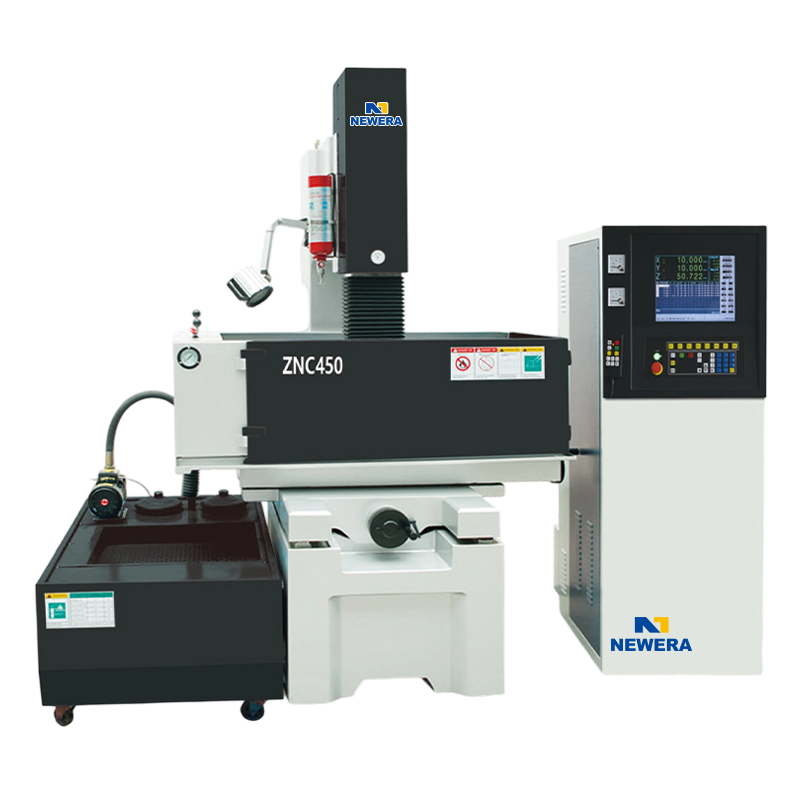
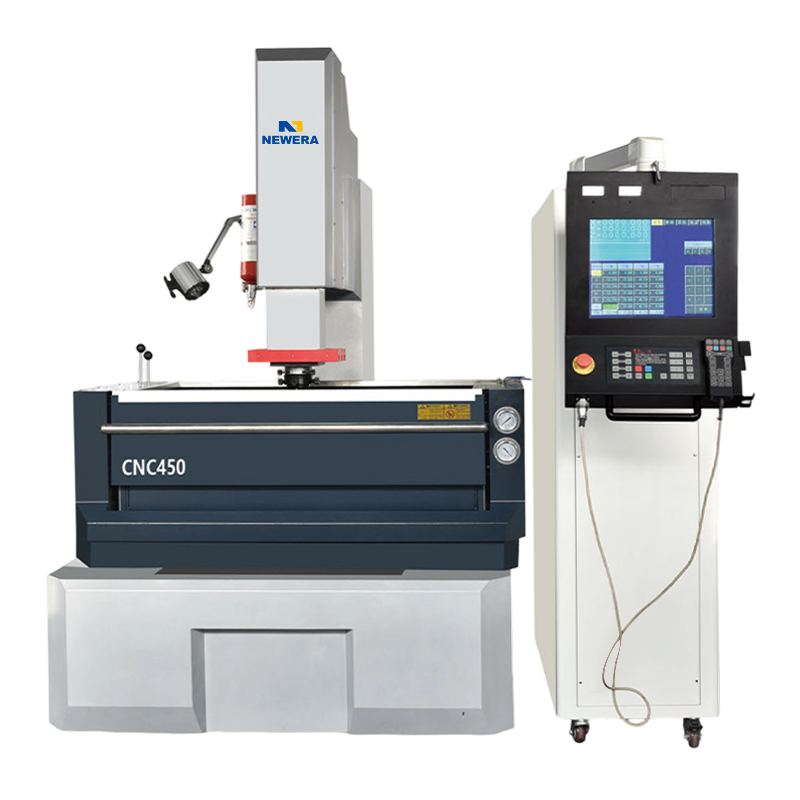
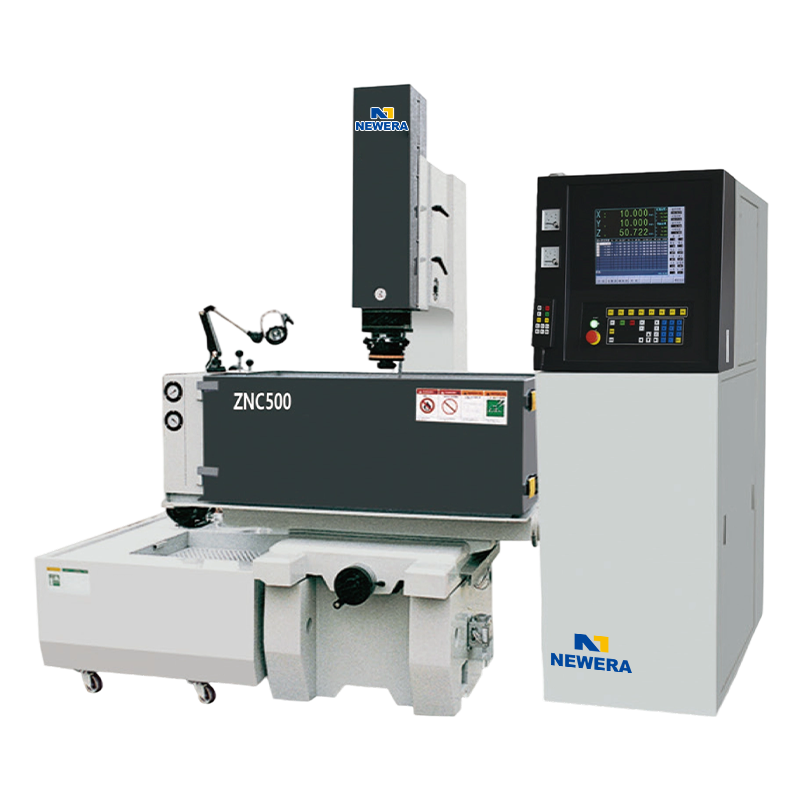
Nantong New Era Technology Co., Ltd. — with over 20 years of specialization in CNC machine tool development and manufacturing — offers the PNC series of die sinking EDM machines, covering a range of work envelope and generator specifications tailored to different production environments. The table below presents a structured comparison of the four core models.
| Model | Work Tank (mm) | X/Y/Z Travel | Max Workpiece Weight | Primary Application |
|---|---|---|---|---|
| PNC 350 | 550 × 400 | 350 / 250 / 250 mm | 300 kg | Prototype tooling, small molds |
| PNC 450 | 650 × 500 | 450 / 350 / 320 mm | 500 kg | Medium molds, tool & die shops |
| PNC 500 | 750 × 600 | 500 / 400 / 400 mm | 800 kg | Injection mold cavities, automotive |
| PNC 550 | 850 × 700 | 550 / 450 / 450 mm | 1200 kg | Large dies, multi-cavity molds |
PNC Series: Max Workpiece Capacity by Model (kg)
Workpiece weight capacity scales significantly across the PNC series, with the PNC 550 supporting four times the load of the PNC 350.
The workpiece weight capacity chart illustrates the substantial scaling across the PNC model range. This is a direct reflection of structural frame size, table reinforcement, and work tank dimensions — all of which increase proportionally. For facilities evaluating a best CNC EDM die sinking machine for mold making in an injection mold context, the PNC 500 and PNC 550 models offer the most appropriate capacity for core and cavity blocks used in medium to large production tools. The PNC 350 and PNC 450 are well-suited for electrode fabrication verification, small insert machining, and prototype tooling where part weight rarely exceeds 500 kg. Selecting one model size above your current maximum requirement provides headroom for future workpiece growth without requiring a machine replacement.
Application-Specific EDM Machine Selection by Industry
Different industries impose distinct demands on their industrial EDM machine manufacturer's products. A medical device toolroom has different tolerancing requirements than an automotive stamping die shop, and an aerospace forging die demands fundamentally different machine capabilities than a consumer electronics mold. Understanding these distinctions sharpens the selection process considerably.
Injection Mold Manufacturing
EDM machines for injection mold manufacturing must deliver high-accuracy cavity replication across a wide range of steel grades, including P20, H13, S136, and NAK80. Typical cavity depths range from 10 mm in a shallow cosmetic housing to over 100 mm in a deep-draw packaging mold. Required surface finish in polished optical molds may demand Ra values below 0.1 μm in finish mode. For this application, prioritize generator fine-finish capability, C-axis rotation for complex undercut profiles, and stable dielectric temperature control that prevents thermal dimensional drift during long programs.
Automotive Stamping and Forging Dies
Automotive die work prioritizes large work envelopes, high material removal rates, and CNC EDM machines for hardened steel at D2 and M2 grades. Surface finish requirements are less stringent than for optical molds — typically Ra 1.6–3.2 μm is acceptable — so roughing productivity matters more than ultra-fine finish capability. For this segment, a PNC 550 with a high peak current generator and automated dielectric management is the natural choice. ATC integration further supports multi-step roughing programs that would otherwise require multiple manual electrode changes.
Precision Tool and Die Shops
General-purpose tool shops handling mixed workloads benefit most from a versatile mid-range machine — the PNC 450 or PNC 500 — with a comprehensive generator parameter library covering both graphite and copper electrode modes. An affordable CNC EDM machine for tool shops in this category should include in-process electrode measurement capability, which eliminates the need for separate pre-setting equipment and reduces electrode setup time by up to 30% in a high-mix, low-volume production context.
Medical Device and Micro-Tooling
Medical and micro-component tooling demands the tightest tolerances of any EDM application — often ±0.002 mm or better — and requires consistent surface uniformity across very small cavity areas. A small CNC EDM die sinking machine with a high-resolution servo system, vibration-damped base structure, and stable thermal environment is preferred over a large-format machine for this work, since smaller machines inherently exhibit lower thermal gradient across the structure. Electrode wear compensation algorithms must be precise enough to maintain dimensional accuracy through multi-hour finishing programs without operator intervention.
EDM Suitability Radar: Application vs. Machine Capability Priorities
Radar comparison of EDM capability priorities across three major industrial application areas.
The radar diagram above highlights that no single machine configuration dominates across all application requirements. Injection mold manufacturing demands a balanced combination of high precision, excellent surface finish, and strong unattended running capability. Automotive die work shifts the priority sharply toward material removal rate and workpiece size capacity — precision and surface finish are less critical in these applications. Micro-tooling for medical devices presents the most extreme precision and surface finish requirements of the three, but operates on very small workpieces with lower material removal rate demands. When interpreting these profiles against available machine models, an industrial EDM machine manufacturer with a multi-model lineup — like the PNC 350 through PNC 550 range — allows buyers to select a machine whose native strengths best match their dominant application profile rather than compromising on a single universal platform.
Surface Finish Standards and What They Mean for Mold Quality
Surface roughness is the primary quality metric for EDM cavity work and is measured in Ra (arithmetic mean roughness) values in micrometers. Understanding the relationship between machine generator settings, electrode material, and achievable Ra is essential for specifying the right high precision EDM machine for your production requirements.
- Roughing (Ra 3.2–6.3 μm): High MRR with graphite electrodes; used in first-pass cavity removal before finishing stages.
- Semi-Finishing (Ra 0.8–3.2 μm): Intermediate stage that removes roughing texture; essential before fine polishing in optical or cosmetic molds.
- Finishing (Ra 0.2–0.8 μm): Low current density, short pulse width, copper electrode preferred; standard for most injection mold cavity production.
- Mirror Finish (Ra below 0.1 μm): Requires dedicated fine-finish generator modes, vibration isolation, and stable dielectric temperature control; used in optical lens molds and high-gloss consumer product tooling.
Relative Machining Time vs. Target Surface Roughness (Ra μm)
Machining time increases non-linearly as target surface roughness decreases — fine finishing requires exponentially more time than roughing.
The line chart above illustrates a critical production planning insight: the relationship between surface finish target and machining time is not linear — it is exponential. Moving from a standard Ra 1.6 μm finishing target to a mirror-quality Ra 0.2 μm target increases machining time by approximately 6 times for the same cavity area. This has significant implications for both machine selection and production scheduling. A precision mold manufacturing EDM solution that requires frequent mirror-finish work must therefore be matched with a machine whose generator is specifically optimized for fine-finish operation, not simply a machine with a large table that is capable of rough cuts. Underestimating the time cost of finish EDM is one of the most common errors in new machine investment planning.
Dielectric System and Flushing: Often Overlooked but Critical
The dielectric system — comprising the fluid reservoir, filtration unit, pump, temperature controller, and flushing circuits — is as important to EDM output quality as the generator itself. Many buyers focus exclusively on generator specifications while overlooking the dielectric management infrastructure, only to discover that inconsistent flushing or uncontrolled fluid temperature is the limiting factor in their surface quality and dimensional repeatability.
Effective debris flushing keeps the inter-electrode gap clear of eroded material, which if left to accumulate causes secondary discharges, surface irregularity, and increased electrode wear. For deep cavity work — particularly in the context of an EDM machine for injection mold manufacturing with blind pockets deeper than 50 mm — programmable orbital flushing paths and through-electrode flushing are important features that a capable CNC sinker EDM machine should support.
Dielectric temperature control is equally important for dimensional accuracy. A temperature variation of just 1°C across the machine structure can induce dimensional drift of several micrometers in a precision cavity program — a significant error when tolerances are ±0.005 mm or tighter. Machines intended for high precision die sinking EDM machine applications should include active dielectric temperature regulation, typically maintaining fluid temperature within ±0.5°C of a set point throughout the machining program.
Evaluating a CNC EDM Machine Manufacturer: What to Look For
Selecting a reliable CNC EDM die sinking machine manufacturer requires evaluating not just the product specification sheet, but the company's engineering depth, after-sales support structure, and track record in your target industry. A machine is a long-term investment — typically 10 to 15 years in a production environment — so the manufacturer's stability and support capability matter as much as the initial specification.
- Years of Specialization: A manufacturer with over two decades of focused CNC EDM development — such as Nantong New Era Technology Co., Ltd. with more than 20 years in the field — demonstrates the accumulated engineering knowledge required to address complex application scenarios.
- OEM and ODM Capability: An OEM/ODM die sinking EDM machine factory that can customize machine configurations for specific applications provides a significantly higher value proposition than a standard off-the-shelf vendor.
- Complete Production and Mounting Center: Manufacturers with vertically integrated production — including their own machining, assembly, and calibration facilities — deliver more consistent quality than those assembling from outsourced sub-components.
- Technology Acquisition Track Record: Look for evidence of ongoing R&D investment and adoption of internationally recognized technological developments in generator design and CNC control systems.
- Application Support Team: A qualified technical team capable of providing process parameter recommendations, electrode design advice, and on-site commissioning support is essential for maximizing the return on any EDM machine investment.
Manufacturer Evaluation Criteria — Rated Importance by Mold Shop Buyers (%)
Survey of mold shop procurement teams on the most important factors when evaluating a CNC EDM machine manufacturer.
After-sales support and precision specification rank as the top two manufacturer evaluation criteria among mold shop buyers — a finding that reflects real-world experience. EDM machines, like all precision manufacturing equipment, require periodic calibration, generator servicing, and software updates over their working life. A manufacturer who delivers a well-specified machine but cannot provide responsive technical support or guaranteed spare parts availability quickly becomes a liability rather than an asset. When evaluating any die sinking EDM machine supplier, request specific commitments on response time for remote diagnostics, on-site service availability in your region, and spare parts lead times for wear items such as filters, seals, and electrode holders.
Pre-Purchase Checklist for EDM Machine Buyers
Before issuing a purchase order for any mold making EDM machine or precision mold manufacturing EDM solution, work through the following structured checklist to confirm all technical and commercial requirements are addressed.
- Define the largest workpiece dimensions and weight you will regularly process.
- Specify the tightest surface finish (Ra) your primary application requires.
- Identify the primary electrode material: graphite, copper, or both.
- Determine whether unattended overnight operation is a production requirement.
- Assess whether an automatic electrode changer (ATC) is justified by shift utilization targets.
- Confirm the machine floor space footprint fits your workshop layout, including access clearance for maintenance.
- Verify that the manufacturer's generator includes dedicated modes for your electrode material and application type.
- Request certification documentation for positioning accuracy and repeatability.
- Confirm spare parts and consumables are available locally or within acceptable lead times.
- Evaluate the manufacturer's training and application support offering for your operating team.
Frequently Asked Questions
Q1: What is a CNC EDM die sinking machine?
A CNC EDM die sinking machine is a CNC-controlled manufacturing system that erodes conductive workpiece material using precisely timed electrical discharges between a shaped electrode and the workpiece, submerged in dielectric fluid. It is widely used to produce complex mold cavities, die inserts, and precision tooling components in hardened steels and other conductive materials without mechanical cutting force.
Q2: How does die sinking EDM work?
Die sinking EDM works by feeding a shaped electrode — typically graphite or copper — toward a conductive workpiece while the pulse generator delivers thousands of controlled spark discharges per second across the gap. Each discharge vaporizes a microscopic amount of workpiece material. The dielectric fluid flushes away eroded debris and controls the gap distance. The electrode shape is progressively replicated as a cavity in the workpiece over multiple roughing and finishing passes.
Q3: What is the difference between die sinking EDM and wire EDM?
Die sinking EDM uses a shaped three-dimensional electrode to replicate a cavity form into the workpiece — ideal for blind pockets, mold cavities, and complex 3D profiles. Wire EDM uses a continuously moving thin wire to cut through-profiles in a workpiece, similar to a bandsaw, and is better suited for producing punches, dies, and contoured extrusion profiles. Die sinking EDM is the correct choice when the cavity does not pass fully through the workpiece.
Q4: What industries use CNC EDM machines?
CNC EDM machines are used across automotive (stamping dies, casting molds), aerospace (turbine blade cooling holes, structural tooling), medical device manufacturing (surgical instrument molds, implant tooling), consumer electronics (smartphone housing molds, connector dies), and general precision toolmaking. Any industry requiring cavities, profiles, or features in hardened or difficult-to-cut materials relies on EDM as a core manufacturing process.
Q5: What materials can be machined with EDM?
Any electrically conductive material can be machined by EDM, regardless of hardness. Common materials include hardened tool steels (D2, H13, M2, P20), stainless steel, titanium alloys, tungsten carbide, Inconel and other superalloys, copper alloys, and graphite. EDM is particularly advantageous for materials above 45 HRC that would cause excessive tool wear or deflection under conventional milling or grinding operations.
Q6: What is the advantage of an automatic electrode changer on an EDM machine?
An automatic electrode changer allows the machine to swap between pre-measured roughing, semi-finishing, and finishing electrodes without stopping for manual intervention. This enables fully unattended overnight or weekend operation across complete multi-stage EDM programs. In high-volume mold production, ATC-equipped machines typically achieve 40–60% higher spindle utilization and significantly reduce the labor cost per cavity compared to manually operated setups.
Q7: Is graphite or copper better as an EDM electrode material?
Graphite is generally preferred for large-area roughing operations due to its high material removal rate, lower electrode wear, and easier machinability. Copper is preferred for fine-detail finishing work where sharp edge definition and very smooth surface finishes are critical, as it produces finer spark discharge characteristics. Many mold shops use graphite for roughing and copper for the final finishing passes on the same cavity to optimize both speed and surface quality.
Q8: How do I choose between a small and large EDM machine model?
Select based on your largest regular workpiece, not your occasional maximum. The target workpiece should occupy no more than 70–75% of the machine's available table travel, leaving room for fixturing. Also consider future production growth — sizing one model step above your current typical workpiece gives headroom for larger molds without requiring a machine replacement. A small CNC EDM die sinking machine like the PNC 350 is ideal for prototype and insert work; larger models suit production mold cavities and multi-impression tools.
If you are interested in our products, please consult us.
CONTACT DETAILS
Nantong New Era Technology Co., LTD
- Five-star Industrial Park, Chongchuan District, Nantong City, Jiangsu Province, China
- TEL:+86-19851302688
- E-Mail: [email protected]
Products
Quick link
Mobile terminal
